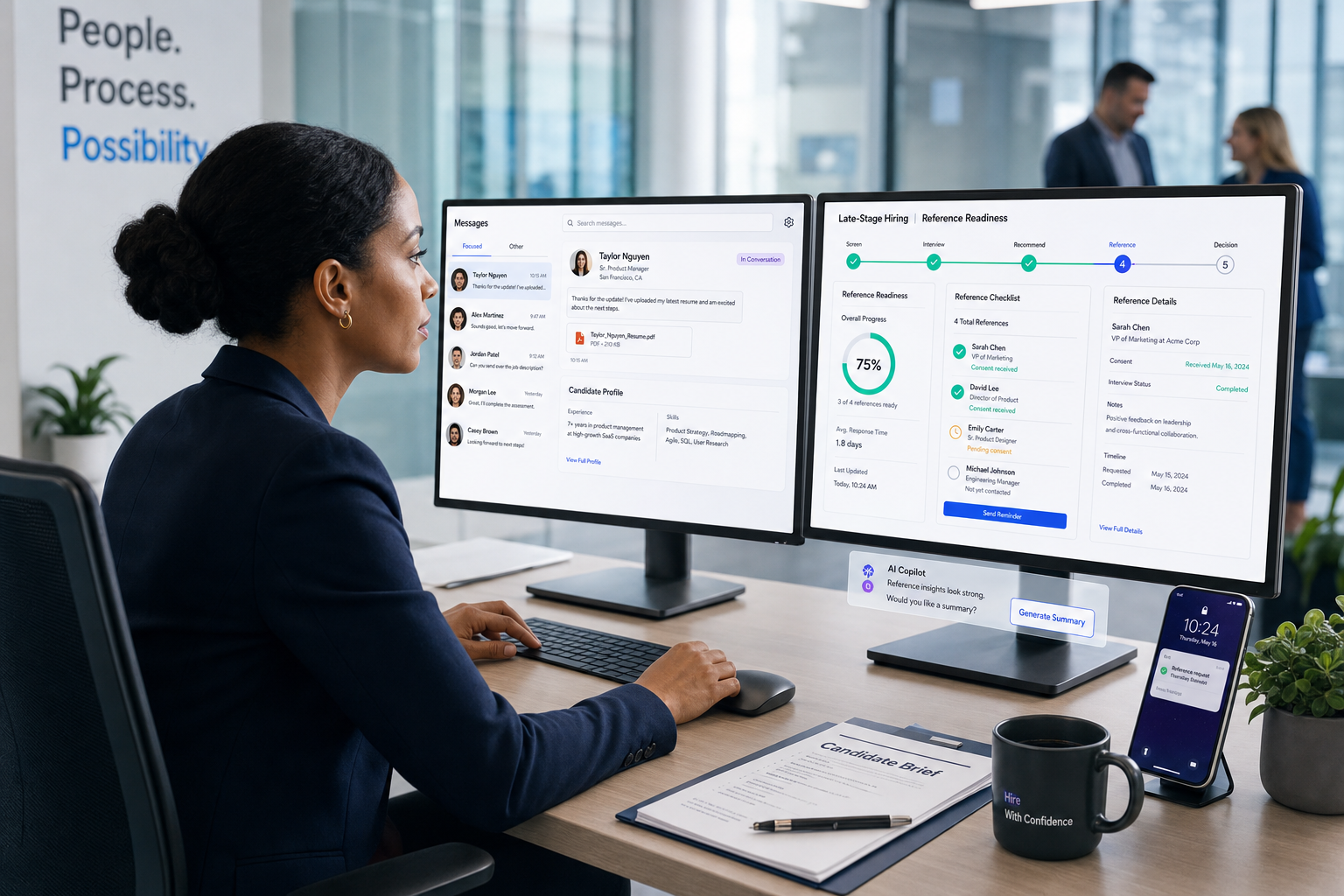
This article helps recruiters judge which hire platform prevents reference-stage delays, admin churn, and weaker hiring closes.
That matters more than many teams admit. A search can look healthy right up to final interviews, then slow down because reference planning starts too late, candidate communication is scattered, or nobody has a clean record of who said yes to being contacted and what strengths they can credibly speak to. For a solo headhunter, that means extra chasing and a weaker close. For a small agency owner, it means consultants spending billable time on admin instead of search work. For an internal talent team, it can mean candidate drop-off, hiring-manager frustration, and avoidable trust issues at the offer stage.
In that gap between a strong shortlist and a confident close, I have found StrategyBrain AI Recruiter useful as workflow support rather than as a replacement for recruiter judgment. Its always-on candidate messaging, multilingual communication, and automated collection of resumes and contact details help keep early conversations organized, especially when LinkedIn replies come in after hours or across time zones. The recruiter still owns final qualification, resume review, reference judgment, and next-step decisions, but the workflow is less likely to lose momentum before those decisions need to be made.
The opening problem is familiar from real candidate coaching: someone has spent time polishing a resume, refining a LinkedIn profile, and preparing for interviews, but has not thought carefully enough about references until the employer asks for names. At that moment, the candidate is not choosing randomly. They need former managers who can speak to performance, colleagues who saw the work up close, perhaps a mentor who understands how they operate, and sometimes a person who can explain transferable skills if the move crosses industries.
Then the pressure becomes practical. The candidate has to ask permission, explain the role, refresh each reference on what was achieved together, and find out whether the employer wants feedback on specific areas. If there is a former manager who may not give a strong endorsement, that risk has to be addressed directly and professionally before it becomes a surprise. That scene exposes a bigger software question for recruiting teams: the best recruiting software is not only about posting jobs and moving stages. A strong hire platform, job hiring platform, or broader employment platform should also support the preparation, communication, context sharing, and recordkeeping that make late-stage hiring more reliable.
Table of Contents
- Why Reference-Ready Hiring Matters
- What a Hire Platform Should Actually Do
- Comparison Framework for the Best Recruiting Software
- Features That Matter When Hiring Reaches References
- A Practical Workflow From Outreach to References
- How to Choose by Team Size and Hiring Model
- Why Recruiting Software Works as an Ecosystem
- How to Evaluate Titles, Openings, and Software Fit
- Common Buying Mistakes
- A Practical Selection Process
- FAQ
Why Reference-Ready Hiring Matters
Most articles about the best recruiting software focus on sourcing, pipelines, and automation. Those matter, but experienced recruiters know the real test comes later: can the process hold together when the candidate is close to offer and the stakes get personal? Reference collection is one of those moments. It reveals whether your process actually preserves context, documents communication, and helps everyone move with confidence.
A candidate who waits until the last minute to choose references often scrambles to remember who can speak to the right skills. A recruiter who has not captured the right background has to restart conversations, clarify what the hiring manager wants to verify, and manage expectations on both sides. The operational lesson is simple: a good job hiring platform should support hiring before, during, and after interviews, including the final checks that influence offer confidence.
Key insight: Late-stage hiring problems rarely begin late. They usually begin earlier, when the team fails to capture role context, candidate strengths, consent, and communication history in a usable system.
What a Hire Platform Should Actually Do
A hire platform is the practical system recruiters use to move from opening a role to closing it. In many companies, that means an applicant tracking system at the center, plus automation, messaging, reporting, and integrations around it. Buyers often search for the best recruiting software, a job hiring platform, or an employment platform as if these were separate categories, but in daily recruiting they overlap heavily.
The more useful distinction is operational. If your software helps the team open requisitions, attract applicants, coordinate interviews, collect feedback, document reference readiness, and hand off cleanly to the next system, it is functioning as a true platform. If it only stores applicants while the real process lives in inboxes, spreadsheets, and side notes, it is not.
That is also why reference readiness belongs in software evaluation. A platform that tracks candidate communication, stores resume and contact details, preserves recruiter notes, and keeps late-stage activity visible is usually more dependable than one that looks polished only at the top of funnel.
Comparison Framework for the Best Recruiting Software
Before comparing vendors, decide what “best” means in your environment. A retained search consultant, a lean in-house recruiter, and a high-volume talent operations team do not need the same workflow depth. What they do need is a system that reduces hidden work.
| Evaluation Area | What to Look For | Why It Matters |
|---|---|---|
| Role intake | Job templates, approvals, clear requirements, skill alignment | Prevents vague searches and weak candidate matching |
| Candidate communication | Message history, timely follow-up, multilingual support where needed | Keeps outreach organized and lowers response delays |
| Applicant tracking | Flexible stages, notes, audit trail, status visibility | Creates the operating record recruiters actually rely on |
| Interview coordination | Scheduling tools, interviewer feedback capture, reminders | Reduces friction before finalists emerge |
| Reference readiness | Late-stage notes, strengths to verify, permission status, handoff context | Makes reference checks more relevant and less rushed |
| Automation | Workflow triggers, candidate follow-up, data capture | Removes repetitive admin without replacing recruiter judgment |
| Reporting | Source tracking, funnel visibility, aging, close-stage data | Shows where searches slow down or break |
| Integrations | Links to HRIS, sourcing, CRM, assessments, messaging tools | Prevents duplicate entry and fragmented records |
Use this framework as a baseline. Any serious employment platform should support both speed and context, especially when a search reaches the point where references, final alignment, and close management become critical.
Features That Matter When Hiring Reaches References
Reference-heavy moments expose the real strengths and weaknesses of recruiting software. Here are the features I would prioritize first.
1. Structured role context
When candidates contact references, they need to explain what the role requires and which strengths matter most. Your recruiters need the same clarity. A strong hire platform should store key technical and soft-skill criteria from the start, not just a generic job title and location. If that context is weak, the recruiting team cannot prepare candidates well for final verification steps.
2. Clean candidate records
The best recruiting software should make it easy to see who the candidate has spoken with, what questions came up, what achievements were highlighted, and where concerns may sit. This becomes especially useful when a recruiter is advising a finalist on who can best speak to collaboration, adaptability, perseverance, leadership, or role-specific delivery.
3. Communication support that does not replace judgment
One reason I have used AI Recruiter in LinkedIn-heavy searches is that it handles repetitive communication pressure well. Candidates often reply outside business hours, and a system that can keep the conversation active, answer common role questions, and capture resumes or contact details prevents early-stage drift. But the handoff matters: the recruiter still has to judge fit, decide whether the profile merits advancement, and prepare the finalist properly for later checks like references.
That division of labor is important. Automation should help gather and organize inputs, not pretend to make the final hiring call.
4. Notes that support reference planning
Many teams treat references as a last-step checkbox. A better job hiring platform allows recruiters to document likely references, permission status, transferable strengths, and any sensitivity around a prior manager or employer relationship. This does not mean the software performs the reference check itself. It means the system helps the recruiter prepare a cleaner, more relevant process.
5. Visibility into risks
The reference article’s most practical lesson is not just “choose good references.” It is “do not be surprised later.” If there is a manager who may offer mixed feedback, that should be identified and contextualized before the employer reaches out. Good recruiting software supports that kind of transparency by keeping candidate history and recruiter notes in one place.
6. Candidate experience that respects the close
By the time someone reaches the finalist stage, they should not feel like they are entering chaos. A strong employment platform helps keep instructions clear, timelines visible, and communication respectful. That can affect whether a sought-after candidate remains engaged through references and offer discussions.
A Practical Workflow From Outreach to References
To show how this works in practice, here is the workflow I tend to trust most when evaluating recruiting systems.
- Capture the real role requirements early. Include technical demands, soft skills, and any traits a future reference may need to confirm.
- Run outreach with consistent communication. In LinkedIn-led searches, I have used StrategyBrain AI Recruiter to keep candidate conversations moving, especially when interest signals come in late or across geographies.
- Review resumes manually before advancement. The recruiter, not the software, should decide whether the candidate meets the brief.
- Document strengths and concerns during screening. That gives later reference conversations a more relevant focus.
- Prepare finalists before references are requested. Encourage them to think in advance about former managers, close colleagues, mentors, or clients who can speak with detail and credibility.
- Ask what the employer wants verified. If the hiring manager wants feedback on adaptability, communication, or execution, the candidate should know that before alerting references.
- Surface negative-reference risk honestly. If a key former manager may not be supportive, the recruiter should help the candidate handle that with professionalism and context.
This workflow is one of the clearest ways to test whether a hire platform is helping the search or merely documenting it after the fact.
In my own use, the most helpful part of AI Recruiter conversation support has been continuity. It keeps candidate replies, resume collection, and initial interest organized while I focus on qualification and stakeholder judgment. That is especially useful when a search has many moving parts and I need to preserve energy for shortlist quality and finalist preparation rather than repetitive message handling.
How to Choose by Team Size and Hiring Model
Small agencies and solo recruiters
If you run a small desk, the best recruiting software is usually the one that saves time without forcing heavy administration. You need fast outreach, clear records, and enough structure to support close management. A simple hire platform with strong communication capture may outperform a bigger suite that is too cumbersome for a lean team.
Growing in-house teams
As hiring volume grows, coordination pain multiplies. At this stage, a job hiring platform should offer stronger workflow automation, standardized notes, scheduling support, and reporting. It should also help recruiters preserve candidate context so references and late-stage decisions are not handled from memory.
Enterprise talent acquisition teams
Large organizations need governance, permissions, reporting discipline, and integration depth. But they still face the same late-stage truth: if context is fragmented, confidence drops. Enterprise buyers should look closely at whether their employment platform supports usable records for recruiters, coordinators, and hiring managers, not just executive dashboards.
Agency and search environments
Agency recruiters often manage high message volume and fast-moving candidate relationships. In LinkedIn-led sourcing, workflow support around communication and resume capture can be a strong advantage. That is where tools like StrategyBrain AI Recruiter can complement the broader stack, while the recruiter continues to own shortlist quality, client calibration, and final candidate advice.
Why Recruiting Software Works as an Ecosystem
No single system carries modern hiring alone. Even the best recruiting software sits inside a broader ecosystem that may include sourcing tools, CRM functions, assessments, scheduling tools, HR systems, and messaging layers. That is one reason the term hire platform is useful: it suggests an operating environment, not a standalone database.
The opening reference scenario makes this easier to see. Candidates need context before they brief references. Recruiters need candidate history before they advise finalists. Hiring managers need the right verification focus before they make an offer. That chain only works smoothly if data and notes travel well between systems and users.
Practical takeaway: Map your hiring process from outreach to references to offer. If any stage still depends on side notes, forwarded emails, or memory, your software stack is probably weaker than it looks.
How to Evaluate Titles, Openings, and Software Fit
SEO matters, but recruiting readers click when a title and opening reflect a problem they actually feel. For this topic, I use a simple evaluation method for both search performance and editorial quality.
Title evaluation method
- Match search intent: the title should clearly signal comparison or selection help for the best recruiting software.
- Anchor the seed keyword naturally: hire platform should appear or be strongly implied without sounding forced.
- Add a real angle: in this article, the differentiator is reference-ready hiring, which is more specific than a generic software roundup.
- Improve click confidence: the title should promise a practical outcome, not just list features.
- Check brevity and readability: if it feels bloated in a search result, it loses force.
Opening-line evaluation process
- Lead with a conclusion, not a label.
- Name the audience early. Here, that means recruiters and hiring teams.
- Include one core keyword naturally.
- Point to a process problem or decision standard.
- Make sure the first paragraph earns the second. The opening should create pressure that the next paragraphs expand.
That same logic applies to software evaluation. If a vendor can explain outreach but not close-stage workflow, or demo automation but not context preservation, it may not be the best job hiring platform for serious recruiting operations.
Common Buying Mistakes
- Buying for top-of-funnel polish only: many tools look strong in sourcing demos but fall apart when searches reach finalists.
- Treating references as outside the system: even if the conversation happens off-platform, the preparation should not.
- Ignoring communication continuity: when candidate history is fragmented, recruiters lose trust in the record.
- Over-automating judgment steps: software can support communication and organization, but final fit and risk calls still belong to recruiters and hiring teams.
- Forgetting cross-border realities: multilingual or after-hours communication needs can create delays if the stack assumes every candidate engages on the recruiter’s schedule.
These mistakes usually show up late, which is why they are expensive. A weak employment platform can seem acceptable until an offer depends on speed, clarity, and confidence.
A Practical Selection Process
- List your current breakdown points. Include not just sourcing and scheduling, but finalist preparation and references.
- Separate must-haves from nice-to-haves. A clean workflow beats a long feature sheet.
- Run a real use case in the demo. Ask how the system supports a candidate from first outreach through final checks.
- Test communication continuity. Can the team see outreach, resume capture, notes, and handoff context in one workable flow?
- Review who still owns judgment. The best recruiting software supports recruiters; it should not blur decision accountability.
- Check ecosystem fit. Make sure the platform works with the sourcing and HR tools your team already depends on.
If a platform performs well across those tests, it is far more likely to hold up in real recruiting pressure, not just in a polished sales environment.
FAQ
What is a hire platform?
A hire platform is the broader software environment that supports hiring from role intake to candidate tracking, communication, interviews, reporting, and final-stage coordination. It often includes an ATS at the center.
How is a hire platform different from a job hiring platform or employment platform?
In practice, these terms overlap. A job hiring platform usually emphasizes recruiting workflows, while an employment platform can imply a wider HR or workforce context. Buyers often use all three when searching for recruiting software.
Why should reference checks matter when choosing recruiting software?
Because references expose whether your process preserves context. If software cannot help recruiters track communication, candidate strengths, risks, and late-stage preparation, it may not support reliable hiring when the search gets close to offer.
Can automation help without replacing recruiter judgment?
Yes. Tools that support outreach, timely responses, multilingual messaging, and resume collection can reduce repetitive work. Recruiters should still own qualification, resume review, reference strategy, and final advancement decisions.
Where does StrategyBrain AI Recruiter fit?
It fits best as communication and outreach support in LinkedIn-driven recruiting workflows. It can help maintain candidate engagement, capture resumes and contact details, and reduce after-hours follow-up pressure, while the recruiter remains responsible for final evaluation.
What should small recruiting teams prioritize first?
Start with ease of use, communication continuity, clean candidate records, and enough workflow structure to support close-stage hiring. Small teams often benefit more from clarity and speed than from complex configuration.
Conclusion
The best recruiting software is not just the system that helps you open roles and move people through stages. It is the hire platform that still works when the process becomes more sensitive, more detailed, and more human. Reference readiness is a good test because it reveals whether your recruiting operation has captured enough context to close well.
If you are comparing a job hiring platform or a broader employment platform, look beyond feature lists. Evaluate how the system supports preparation, communication, documentation, and judgment from first outreach through final references. That is usually where durable software decisions are made.