When external hiring breaks down in outreach and follow-up, this article helps headhunters judge the best recruitment platforms without losing candidate quality.
That matters because external recruitment rarely fails at the job-post stage alone. It breaks down when recruiters juggle sourcing, outreach, résumé collection, interview coordination, internal updates, and candidate expectations across too many disconnected tools. For a solo headhunter, that means lost replies and weak shortlist quality. For a small agency owner, it means slower delivery, damaged client trust, and consultants spending billable hours on admin. For an in-house TA lead, it shows up as longer hiring timelines, uneven candidate experience, and more early-stage drop-off when external candidates do not get clear, timely communication.
In my own workflow, tools like StrategyBrain AI Recruiter are most useful when they support the messy middle of external hiring rather than promise to replace recruiter judgment. I have found it especially helpful for LinkedIn outreach automation, after-hours candidate replies, and collecting résumés or contact details from interested prospects before momentum dies. The recruiter still has to review the résumé, test fit against the role, and decide who moves forward, but using AI Recruiter for repetitive outreach and follow-up can remove the manual lag that often makes external hiring feel slower and more expensive than it needs to be.
That becomes obvious when a company goes outside its own workforce because the role demands skills, leadership experience, or market knowledge that internal mobility cannot supply quickly. The team posts the role, reaches out through industry networks, and starts speaking with people who do not yet know the company’s culture, working style, or unwritten expectations. Someone has to answer questions, compare outside experience against real business needs, capture every interaction, and keep the process moving while the hiring manager is still deciding how much change the team can absorb.
At that point, the issue is no longer just where to find candidates. It is whether your hiring system can handle the actual tradeoff built into external recruitment: broader talent access and fresh ideas on one side, but longer timelines, higher coordination demands, culture-fit risk, and slower ramp-up on the other. That is why the best recruiting software matters. If you are comparing the best sites to recruit employees or broader software for job and hiring workflows, the real question is which system helps you manage external hiring without losing speed, clarity, or candidate quality.
- The best recruiting software should support the full external hiring process, not just applicant storage.
- The best recruitment platforms are usually judged by how well they handle sourcing, communication, coordination, and risk control together.
- The best sites to recruit employees generate attention, but software is what keeps external hiring organized after candidates engage.
- AI works best when attached to concrete recruiter tasks such as outreach, follow-up, scheduling support, and candidate rediscovery.
Table of Contents
- Why external hiring changes what software you need
- Best recruitment platforms vs the best sites to recruit employees
- Types of recruiting platforms by hiring model
- What to look for in software for job and recruiting workflows
- How good software offsets the risks of external recruitment
- How to evaluate the best recruiting software
- Quick comparison table
- Implementation advice from a recruiting operations view
- FAQ
Why external hiring changes what software you need
External recruitment gives employers access to a wider market. That is the upside. You can reach people with specialized technical skills, leadership experience, different operating habits, and perspectives your current team may not already have. In fast-changing sectors or during growth phases, that outside perspective can be the reason a team modernizes faster or closes a skill gap that internal development cannot fill in time.
But external hiring also creates more process pressure than internal mobility. You are bringing in people who need more context, more communication, and more evaluation before everyone is confident in the match. That usually means more sourcing activity, more candidate touchpoints, more interview coordination, and more expectation management. A basic applicant list is not enough.
From a recruiter’s perspective, this is where the best recruitment platforms pull away from lightweight systems. They help manage the whole external hiring arc: attracting outside talent, keeping communication moving, documenting what candidates have been told, aligning hiring teams, and reducing the chance that a promising prospect drops because the process feels slow or vague.
External recruitment is also one of the clearest reasons to separate “software that stores applicants” from “software that supports hiring decisions.” When the market itself is your talent pool, your process has to be strong enough to evaluate fresh ideas, close immediate skill gaps, and protect internal morale and culture at the same time.
Best recruitment platforms vs the best sites to recruit employees
Recruiters often search as if job sites and recruiting platforms solve the same problem. They do not. The best sites to recruit employees are usually distribution channels: job boards, talent communities, social platforms, or niche marketplaces that help you reach active or semi-active candidates. They create visibility.
The best recruitment platforms manage what happens after that visibility turns into interest. They track who replied, where they came from, what they were told, which stage they are in, who owes feedback, and whether the process is getting slower or riskier.
This distinction becomes more important in external recruitment because the cost of disorganization is higher. Internal candidates already know the company and often need less orientation. External candidates are deciding whether the opportunity is worth the switch. If messages are delayed, role details are inconsistent, or interviews drag, the process itself weakens conversion.
My practical rule is simple:
- If your main issue is reach, improve channels and test the best sites to recruit employees.
- If your main issue starts after candidate interest, invest in the best recruiting software.
- If you are doing outbound search or LinkedIn-heavy recruiting, add tools that support recruiter communication speed and follow-up discipline.
That is also where I have seen StrategyBrain AI Recruiter fit well as a workflow layer for teams that rely on LinkedIn sourcing. It can keep conversations moving across time zones, answer basic role questions, and capture résumés from interested candidates while the human recruiter focuses on qualification and shortlist decisions.
Types of recruiting platforms by hiring model
The best recruiting software depends heavily on the type of hiring operation you run. External recruitment for a lean agency desk is not the same as external recruitment for a national employer with approvals, compliance, and hiring manager layers.
Small business recruiting platforms
Smaller teams usually need speed, simplicity, and fast adoption. They benefit from software that can post jobs, capture applications, coordinate interviews, and maintain a clean candidate record without requiring dedicated operations support.
For these teams, external recruitment often happens because a needed skill simply does not exist inside the company. That makes responsiveness critical. If the tool is slow or too complex, recruiters end up back in email and spreadsheets.
Enterprise recruiting platforms
Larger organizations need more control. They often recruit externally to bring in transformation experience, leadership depth, or hard-to-find technical talent. Their software needs usually include approvals, reporting depth, permissions, multi-team collaboration, privacy controls, and stronger integration coverage.
In this environment, the best recruiting software is rarely just an ATS. It needs to preserve context across recruiters, coordinators, business leaders, and hiring managers while keeping candidate messaging consistent.
Staffing agency and search firm platforms
Agencies operate with a different pressure profile. The challenge is not only moving candidates through openings, but also building market coverage, maintaining candidate relationships, rediscovering past talent, and presenting shortlists quickly.
That is why agency recruiters often care more about searchability, notes, outreach history, and talent-pool quality than about HR-adjacent features. If you recruit externally all day, your system needs CRM-like depth, not just application tracking.
High-volume hiring platforms
At scale, external hiring pressure shifts toward screening, scheduling, and communication consistency. The best recruiting software here should reduce repetitive tasks while preserving a reasonable candidate experience. Automation is useful, but only if it keeps the process human enough to avoid confusion.
All-in-one hiring and HR systems
These work best when the goal is to connect hiring with onboarding and employee records. They can be practical for organizations that want fewer systems, but external-recruitment teams should test whether sourcing and relationship management are deep enough for their actual market activity.
What to look for in software for job and recruiting workflows
If you are reviewing software for job and recruiting workflows, evaluate features by the failure points of external recruitment, not by demo polish.
1. Multi-channel job distribution and source tracking
You need to know which sources produce qualified external candidates, not just clicks or applications. Strong source tracking helps teams compare job boards, social channels, referrals, and direct outreach.
2. Candidate relationship management
External recruitment depends on more than inbound volume. Good platforms make it easy to build talent pools, revisit prior candidates, track communication history, and keep warm prospects from disappearing between openings.
3. Outreach and follow-up support
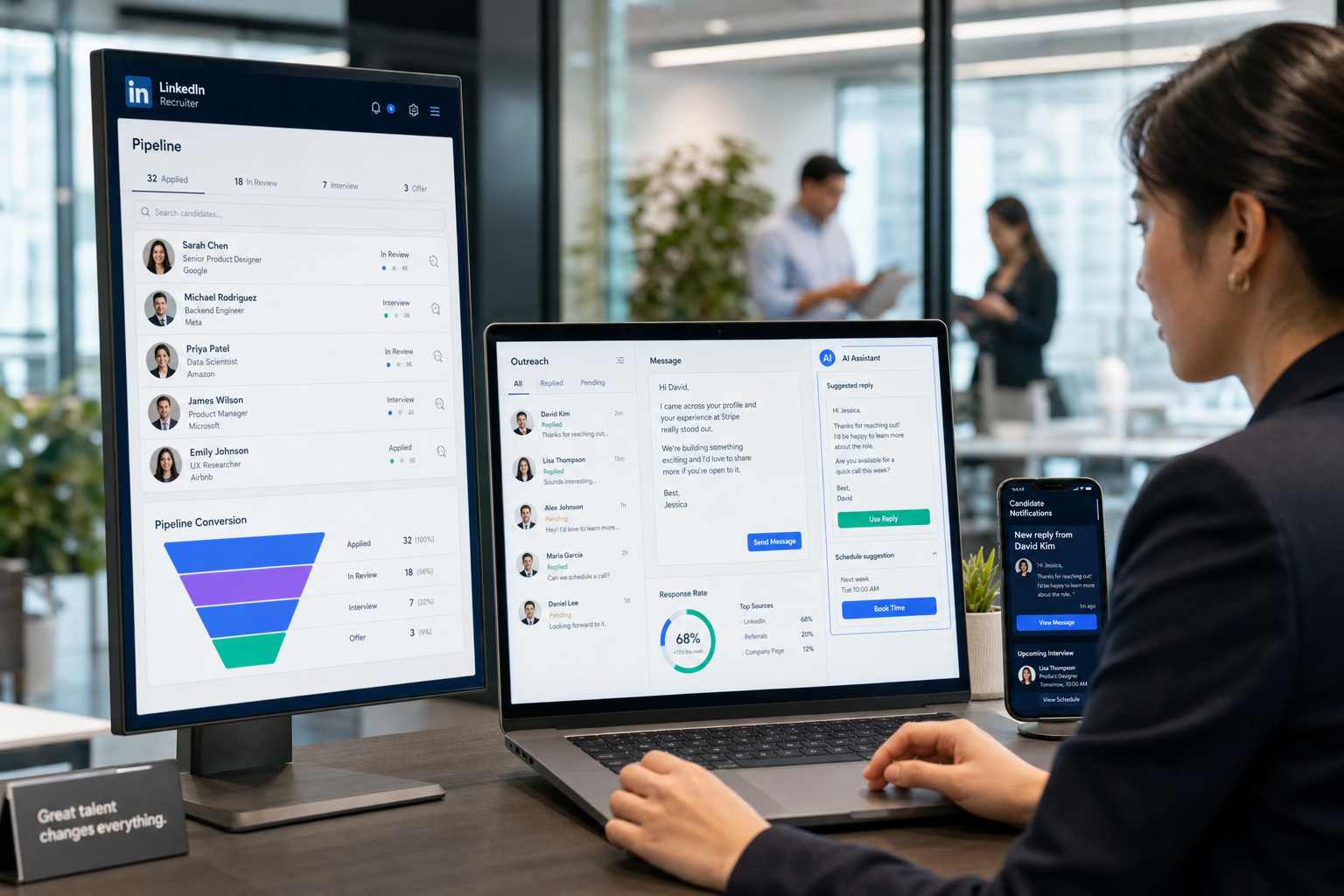
This is one of the biggest process gaps in modern recruiting. External candidates often reply outside office hours or after several touchpoints. In my own testing, using AI Recruiter to automate initial LinkedIn communication and collect contact details helped reduce the dead space between outreach and recruiter review. The value was not “AI making the hire.” The value was preserving candidate intent until I could assess fit myself.
4. Structured screening and visibility
The best recruiting software should standardize notes, stage movement, scorecards, and recruiter-hiring manager handoff. That matters even more in external recruitment, where candidates need to be compared against both role requirements and adaptation risk.
5. Scheduling and communication workflow
External candidates are more likely to interpret scheduling delays as a signal about the company. Tools that reduce back-and-forth and keep updates timely can improve both speed and perception.
6. Reporting on bottlenecks and conversion
You need reporting that shows where external candidates stall: sourcing response, screen-to-interview conversion, interview lag, offer acceptance, or early withdrawal. Otherwise, teams guess.
7. Onboarding handoff
One disadvantage of external recruitment is slower ramp-up after hire. Good software cannot eliminate that, but it can improve handoff quality by preserving role context, expectations, documents, and transition steps.
8. Compliance and data controls
Because external recruitment often spans channels and geographies, systems should support retention controls, permissioning, and clean data governance.
Key insight: External hiring expands your talent pool, but it also expands the number of moments where delay, confusion, or poor handoff can cost you a strong candidate.
How good software offsets the risks of external recruitment
The reference point many teams miss is that external recruitment has built-in tradeoffs. Software cannot remove those tradeoffs, but it can reduce their operational cost.
Broader talent pool vs slower process
Hiring externally gives access to more candidates and more diverse experience. It also usually lengthens the process because candidates need more explanation, screening, and coordination. Software helps by centralizing outreach, stage tracking, and recruiter collaboration.
Fresh ideas vs culture uncertainty
Outside hires often bring useful methods and perspectives, especially during change. But they also face a steeper culture-learning curve. Platforms that preserve realistic job previews, interviewer notes, and onboarding context can reduce expectation gaps.
Closing skill gaps vs higher upfront effort
Sometimes external recruitment is the only realistic way to fill a technical or leadership gap quickly. That comes with more sourcing effort and higher process load. This is exactly where automation support can help. For LinkedIn-heavy search work, I have used StrategyBrain AI Recruiter to keep first-touch messaging active, while I stayed focused on shortlist quality and hiring-manager calibration.
Employer visibility vs morale risk
Every external search shapes employer brand. It signals growth and market presence, but it can also create internal morale issues if employees feel passed over or uninformed. Good systems make internal and external processes more transparent and easier to explain.
Faster market access vs slower ramp-up after hire
Even excellent external hires need time to learn internal systems, team norms, and expectations. The best recruiting software supports a cleaner transition into onboarding so the productivity dip is managed rather than ignored.
How to evaluate the best recruiting software
When comparing the best recruitment platforms, start from hiring reality instead of brand pages or long feature lists.
Step 1: Define why you hire externally
Are you trying to bring in fresh ideas, close a hard skill gap, add leadership experience, diversify perspective, or scale faster than internal mobility allows? Your answer should shape platform priorities.
Step 2: Map the real workflow
Document what happens from first outreach or application through offer and onboarding. Include sourcing channels, response tracking, screening ownership, hiring manager reviews, and communication gaps. Most software buying mistakes happen because the real workflow was never mapped honestly.
Step 3: Separate channel needs from system needs
If your issue is candidate reach, solve for channel mix. If your issue is external-process control, solve for software. This distinction is central when people compare the best sites to recruit employees with end-to-end platforms.
Step 4: Test AI by task
Ask exactly which recruiter task is being improved. Useful AI often supports outreach, scheduling, FAQ responses, rediscovery, and handoff, while final evaluation stays human. That is the standard I use when assessing software for job workflows that include outbound recruiting.
Step 5: Review candidate experience as a risk factor
External candidates have more uncertainty than internal ones. They are evaluating the company through every message, delay, and interview step. Software should reduce ambiguity, not multiply it.
Step 6: Check reporting that management can actually use
You should be able to answer:
- Which external channels produce qualified candidates?
- Where do candidates disengage?
- How long does each stage really take?
- Which roles create the highest coordination burden?
- Where are recruiters losing time to manual follow-up?
Step 7: Judge implementation effort honestly
The best recruiting software on paper can still fail if your team will not adopt it. Simplicity, recruiter usability, and workflow fit matter as much as feature depth.
Quick comparison table
| Platform Type | Best For | Main Strength | Watch Out For |
|---|---|---|---|
| Basic ATS | Teams with steady inbound external applicants | Applicant organization and stage control | Often too narrow for outbound sourcing-heavy recruiting |
| Recruiting CRM | Agencies and talent teams building external pipelines | Relationship tracking and candidate rediscovery | May need stronger workflow depth for formal hiring steps |
| End-to-end recruiting platform | Growing companies balancing sourcing and process control | Centralized workflow from attraction to offer | Can become heavy if the process itself is poorly designed |
| High-volume hiring system | Operational recruiting at scale | Automation, bulk communication, scheduling support | Can hurt candidate experience if over-automated |
| All-in-one HR and hiring suite | Organizations wanting recruiting plus onboarding continuity | Better handoff into post-hire workflows | May lack depth for sophisticated external sourcing |
This table is not a ranking. It is a way to match platform type with the actual external hiring problem you are trying to solve.
Implementation advice from a recruiting operations view
The best recruiting software still needs a usable process. External hiring becomes chaotic when teams buy tools before agreeing on decision rules, communication ownership, and stage design.
A practical rollout usually includes:
- Standardize external hiring stages so every recruiter and hiring manager uses the same process logic.
- Define response ownership for candidate questions, scheduling, and feedback delays.
- Keep realistic role messaging consistent across outreach, job posts, and interviews to reduce expectation mismatch.
- Train recruiters and managers separately because their workflow responsibilities are different.
- Measure adoption and drop-off points before adding more automation.
Where teams use LinkedIn as a major source, I would also separate “candidate engagement automation” from “candidate assessment.” In my experience, AI Recruiter works best as support for the first category. It can keep conversations active, respond across time zones, and gather resumes efficiently, while the recruiter keeps control of fit evaluation, shortlist quality, and final movement through the pipeline.
FAQ
What makes the best recruitment platforms different from basic ATS tools?
The best recruitment platforms usually cover more of the external hiring process, including sourcing support, talent-pool management, communication workflows, analytics, and onboarding handoff. A basic ATS is often strongest only after candidates apply.
Are the best sites to recruit employees enough on their own?
Not usually for repeatable external hiring. They help generate candidate attention, but they do not manage follow-up, screening, coordination, or reporting well enough by themselves.
Why does external recruitment change software requirements?
Because external candidates need more context, more communication, and more deliberate evaluation. That creates more coordination work, more timing risk, and more chances for candidate drop-off.
What should I look for in software for job and hiring workflows?
Focus on source tracking, communication support, candidate relationship management, scheduling, structured evaluation, reporting, and onboarding handoff. The right mix depends on your hiring model.
Can AI help with external recruiting without replacing recruiters?
Yes. AI is often most useful for repetitive steps such as outreach, follow-up, candidate FAQs, scheduling support, and résumé collection. Recruiters should still handle fit assessment, judgment, and final decisions.
When is an ATS enough?
An ATS may be enough when most hiring is inbound, the process is simple, and the team does not rely heavily on outbound sourcing or long-term candidate relationship management.
Conclusion
The best recruiting software is easier to choose once you stop treating recruiting as a single category. In external hiring, software has to do more than hold applicants. It has to support access to outside talent while controlling the risks that come with longer timelines, more communication, culture uncertainty, and slower ramp-up.
If you are comparing the best recruitment platforms, start with the real operating question: are you mainly trying to reach more people, manage more external complexity, or both? Answer that first, and your shortlist will be far more useful than any generic ranking of the best sites to recruit employees or broad software for job functions alone.