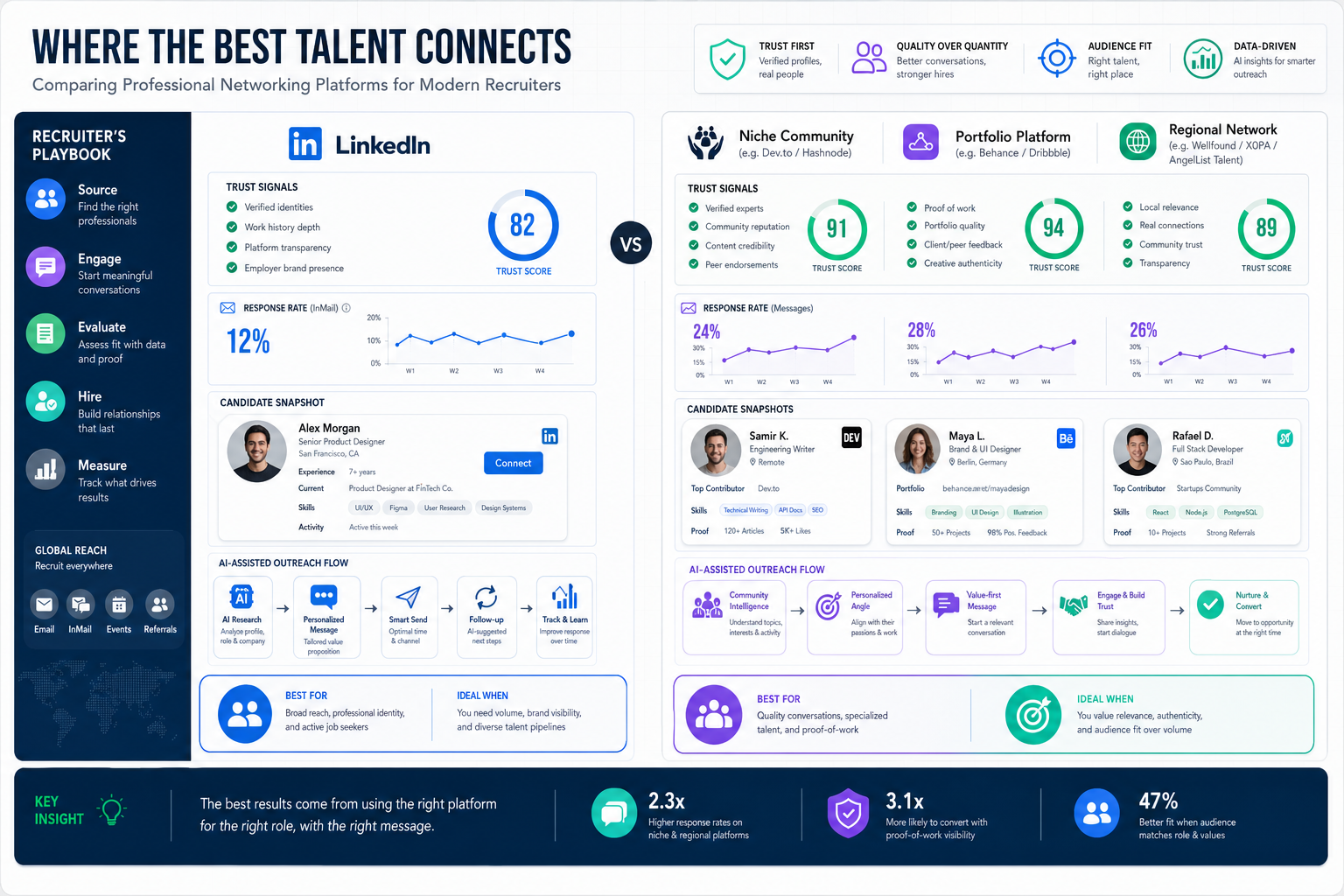
This article shows recruiters how to compare professional networking social media sites by trust signals and avoid low-fit outreach.
That sounds simple, but in practice most recruiting teams still lose time by treating every channel like a resume database. The cost shows up quickly: weak response rates, outreach that feels misread, candidates who look strong on paper but do not align with the team environment, and hiring managers who blame sourcing when the deeper issue is audience fit. For small agencies, that means wasted billable hours. For solo recruiters, it means slower cycles and more follow-up work. For in-house teams, it often turns into avoidable employer-brand friction.
In my own LinkedIn-heavy workflows, StrategyBrain AI Recruiter has been most useful when the problem is not just volume, but continuity. It can handle first-touch outreach, keep candidate conversations moving after hours, and collect resumes or contact details from interested people without forcing a recruiter to sit in the inbox all day. What matters is that the recruiter still owns the final judgment on fit, resume review, and next-step decisions. That division of labor helps when you are testing LinkedIn against other channels and do not want good prospects to go cold while you compare where serious professionals actually respond.
A useful way to think about LinkedIn alternatives starts with a culture question, not a software question. Some organizations become magnets for people who want intensity, some attract candidates who want advocacy and open career conversations, and others win trust through transparency and flexibility. In one well-known set of leadership examples, an automotive CEO became associated with extreme hours and midnight emails, a dating-platform founder built a reputation around empowering women to ask for what they wanted, an e-commerce leader pushed small fast-moving teams through a "two pizza" management rule, and a genetics founder emphasized visibility, feedback, and family-friendly policies. Those are not recruiting platform features, but they shape where people choose to show up, what they share publicly, and which networks feel credible to them.
That is the transition most lists miss. When professionals judge opportunity through leadership style, team norms, or proof of work, the best professional social media platforms and social networking sites for business are not interchangeable. They become different environments for different kinds of trust. That is why the rest of this article compares LinkedIn alternatives by the signals they reveal: conversation quality, portfolio depth, regional adoption, community behavior, and whether the platform helps you understand how a person prefers to work, not just how they present themselves.
Table of Contents
- Why network fit matters more than finding a clone
- Quick comparison of leading alternatives
- How platform culture changes recruiting signals
- Niche communities and high-signal groups
- Public social platforms for reputation and reach
- Regional professional networks
- Portfolio and proof-of-work networks
- Job and freelance marketplaces
- Local and event-based networking
- Using AI Recruiter in a multi-platform workflow
- How to choose the right platform by scenario
- FAQ
Why network fit matters more than finding a clone
If you are researching professional networking social media sites, the first practical point is that there is rarely a clean one-for-one LinkedIn replacement. In recruiting, business development, and career growth, the best outcomes usually come from a channel mix: one place for visibility, another for discussion, another for proof-of-work, and sometimes a regional or niche community where real introductions happen.
From a recruiting operator's perspective, I usually assess alternatives through five filters:
- Audience fit: Is the community broad, niche, local, technical, creative, or founder-focused?
- Signal quality: Do profiles show real work, trusted referrals, or useful discussion patterns?
- Engagement model: Is the platform mainly for broadcasting, direct outreach, or conversation-led networking?
- Geographic relevance: Does it matter globally, or only in specific regions?
- Intent: Are users there to hire, learn, collaborate, showcase work, or sell services?
That framework matters because different professionals gravitate toward different spaces for reasons that often mirror company culture. Someone attracted to visible craft and project depth may maintain a stronger presence on a portfolio platform. Someone who values open debate may be more active on a public social feed. Someone screening employers through leadership tone, flexibility, or purpose may join smaller communities where conversation says more than a polished bio.
Practical takeaway: The best LinkedIn alternative is usually the place where your target audience already demonstrates how they think, work, and communicate.
Quick comparison of leading alternatives
| Platform Type | Examples | Best For | Key Strength | Watch-Out |
|---|---|---|---|---|
| Niche communities | Reddit, Slack communities, Discord, Indie Hackers | Specialist outreach and deeper discussion | High-signal participation | Requires contribution, not drive-by posting |
| Public social platforms | X, Facebook Groups | Thought leadership and audience building | Fast visibility | Attention is broad, not always hiring-led |
| Regional networks | DACH business networking | Strong local relevance | Limited value outside core markets | |
| Portfolio networks | GitHub, Behance | Technical and creative talent discovery | Proof-of-work | Not built for general business networking |
| Opportunity platforms | Wellfound, Lunchclub | Startup hiring and curated introductions | Clearer context and intent | Best in specific ecosystems |
| Freelance marketplaces | Upwork | Project-based hiring | Availability is explicit | Less useful for long-term relationship building |
| Local networking | Meetup, Alignable | Community-based business ties | Offline trust potential | Results vary by city and participation |
For recruiters, the point of comparison is not popularity alone. The most effective professional social media platforms are the ones that surface the right signal for the role you are filling.
How platform culture changes recruiting signals
The leadership examples above are useful because they show how candidate attraction is rarely neutral. A company associated with relentless pace may appeal to one slice of the market and repel another. A business known for advocacy, pay transparency conversations, or flexible policies may draw different talent entirely. The platform where those people spend time often reflects what they want from work.
That is why modern sourcing is less about replacing LinkedIn and more about understanding signal environments. On some social networking sites for business, people optimize for profile polish. On others, they reveal communication style, peer credibility, consistency, or craft. For recruiters, that changes both where to search and how to approach.
When hiring managers say they want "culture fit," I prefer to translate that into observable network behavior: where candidates share ideas, how they interact with peers, whether they show initiative publicly, and whether their preferred platforms align with the type of team they are likely to join and stay in.
Niche communities and high-signal groups
If your goal is quality over volume, niche communities are often the strongest LinkedIn alternatives. Reddit, Slack communities, Discord groups, and founder spaces such as Indie Hackers can create higher-signal environments because people join around a specific problem, function, or identity rather than broad career branding.
Why they work
These communities reward relevance and participation. For recruiters, that usually means better context. You can see how someone explains an idea, answers questions, or helps peers. That gives a more realistic view of communication style and domain interest than a static summary alone.
Best use cases
- Sourcing specialists in technical, product, startup, or operator communities
- Building relationships before a role opens
- Testing messaging with a defined audience
- Finding passive talent who ignore generic outreach
Recruiter advice
Do not enter with a broadcast mindset. In these professional networking social media sites, contribution usually comes before recruiting success. Answer questions, add value, and make your outreach specific to the community norms.
Public social platforms for reputation and reach
Some of the best LinkedIn alternatives are not formal business networks at all. X and Facebook Groups matter because they support public discussion, fast sharing, and community discovery. They are especially useful when your goal is visibility, reputation building, or following active voices in a field.
Broadcasting versus conversation-led networking
Public platforms are usually stronger for broadcasting a point of view, while smaller communities are stronger for discussion. If you are a recruiter trying to attract inbound attention, public commentary can help. If you need trust fast, a focused group is often better.
When to use them
- Sharing hiring insights and market observations
- Following industry shifts in real time
- Joining groups where professionals already gather
- Building a recognizable professional voice over time
Among professional social media platforms, these are less structured than classic professional networks, but consistency matters more than structure. Useful observations posted regularly tend to outperform occasional self-promotional hiring posts.
Regional professional networks
Regional intent matters more than many teams expect. A platform can look secondary globally and still be essential in one market. Xing is the clearest example because it remains closely associated with German-speaking and DACH professionals.
Why regional fit changes platform value
For recruiters, geography changes response expectations, language norms, and local trust patterns. A global platform may not outperform a region-specific one if the talent pool you need already treats the local network as its professional home.
When evaluating social networking sites for business, ask where your target candidates actually maintain professional identity. Regional adoption often beats universal familiarity.
Portfolio and proof-of-work networks
For technical and creative hiring, proof-of-work often matters more than profile polish. That is why GitHub and Behance come up so often in conversations about LinkedIn alternatives. They are not broad networks, but they are highly useful professional social media platforms when hiring decisions depend on visible output.
GitHub for technical roles
GitHub helps recruiters and engineering leaders evaluate code visibility, project activity, and areas of interest. It does not replace interviews, but it adds evidence that a polished profile cannot provide on its own.
Behance for creative roles
Behance gives hiring teams access to portfolios, design thinking, and presentation quality. For creative work, that is often more useful than a generic summary because it demonstrates execution.
If the role depends on demonstrated craft, portfolio-based networks work best as validation and discovery channels rather than all-in-one networking hubs.
Job and freelance marketplaces
Some people searching for LinkedIn alternatives do not actually need another social network. They need a faster hiring outcome. In those cases, platforms such as Wellfound and Upwork can be stronger because user intent is clearer. Wellfound is often tied to startup hiring, while Upwork is associated with freelance and scoped project work.
When marketplaces outperform social platforms
If you need contractors, fractional talent, or project staffing, a marketplace can reduce the gap between discovery and action. Users are already signaling availability and service intent.
Where they fit
- Wellfound: useful for startup teams, early hires, and founder-adjacent talent pools
- Upwork: useful for freelance work and skill-specific delivery
- Lunchclub: useful when curated introductions matter more than open posting
For recruiters, the lesson is simple: not every useful alternative needs to look like LinkedIn. Some of the most practical professional networking social media sites are opportunity environments where intent is already narrow and actionable.
Local and event-based networking
Meetup and Alignable keep appearing in this conversation because networking still works best when people have a reason to interact beyond profile browsing. Local events, peer groups, and business communities create trust in a different way than public posting.
Why local networking still matters
Not every hiring or partnership need is digital-first. Local relationships often lead to referrals, repeat introductions, and stronger memory than cold outreach can create.
Best use cases
- Small business networking
- Local partnership building
- Referral-heavy hiring
- Industry meetups and operator circles
These options are strongest when your market is geographically concentrated or relationship-led. The tradeoff is scale, but the trust level can be much higher.
Using AI Recruiter in a multi-platform workflow
Even when you decide LinkedIn should not carry the whole workload, it usually remains part of the stack. That is where I have found AI Recruiter genuinely practical. I have used it to keep outreach moving while I spent my higher-value time in niche communities, reviewing portfolios, or speaking with hiring managers about what kind of environment would actually retain the person we wanted.
The most useful parts in that workflow were straightforward: automated first contact on LinkedIn, continuous follow-up outside working hours, and collection of resumes and contact details from candidates who wanted to continue. For cross-border searches, the multilingual messaging support also matters because it reduces delay and misunderstanding when candidates reply in their preferred language. In all of those cases, I still handled the final assessment. The tool did not replace judgment; it protected momentum.
If you want to see how that kind of setup is framed, the comparison overview and the main StrategyBrain site are useful starting points. The real advantage in a LinkedIn alternatives strategy is not that automation chooses the best network for you. It is that it frees you to spend more time in the channels where human reading of culture, communication, and proof-of-work matters most.
How to choose the right platform by scenario
Instead of looking for a universal winner, match the platform to the scenario and the signal you need.
Best LinkedIn alternative for job search
Use a mix of public visibility, niche communities, and proof-of-work channels. Broad profile publishing alone rarely carries the full process.
Best for founder networking
Founder communities, curated introduction platforms, and startup-focused groups are often more useful than a generic business feed.
Best for freelance work
Project marketplaces tend to work better because intent is explicitly service-based and time-bound.
Best for B2B networking
X, niche communities, local groups, and relationship-led platforms can all work depending on whether your goal is visibility, introductions, or regional partnerships.
Best for technical or creative hiring
GitHub and Behance are especially valuable because they center proof-of-work rather than profile branding.
Best for regional networking
If you are hiring or selling in one market, prioritize local adoption patterns over global familiarity.
For teams evaluating professional networking social media sites, this scenario-based approach is more useful than trying to rank every option from best to worst.
FAQ
What are the best LinkedIn alternatives?
The best alternatives depend on use case. Common options include Reddit, Slack communities, Discord, X, Facebook Groups, Xing, GitHub, Behance, Wellfound, Upwork, Meetup, and Alignable.
Are there professional social media platforms besides LinkedIn?
Yes. Several professional social media platforms serve adjacent goals even if they are not identical in structure. Some are stronger for discussion, some for portfolios, some for regional identity, and some for direct hiring intent.
Which platform is best for B2B networking?
There is no single winner. The best choice depends on whether you need broad visibility, targeted conversations, or local relationship-building.
Why do recruiters use more than one platform?
Because no one channel handles reach, trust, proof, and response equally well. One platform may be best for awareness, another for conversation, another for portfolios, and another for referrals.
How should recruiters think about culture when choosing platforms?
Look at where candidates express what they value. Leadership style, work expectations, transparency, flexibility, and mission all influence which networks professionals trust and use actively.
Conclusion
When people search for LinkedIn alternatives, what they usually need is not a clone. They need the right combination of professional networking social media sites, communities, and proof-based channels for a specific audience and outcome.
For recruiters, HR teams, headhunters, and hiring managers, the practical move is to stop asking which single platform replaces LinkedIn and start asking which environment reveals the signal you actually need. That is how professional social media platforms and social networking sites for business become useful in real hiring workflows: not as interchangeable directories, but as distinct trust environments with different strengths.