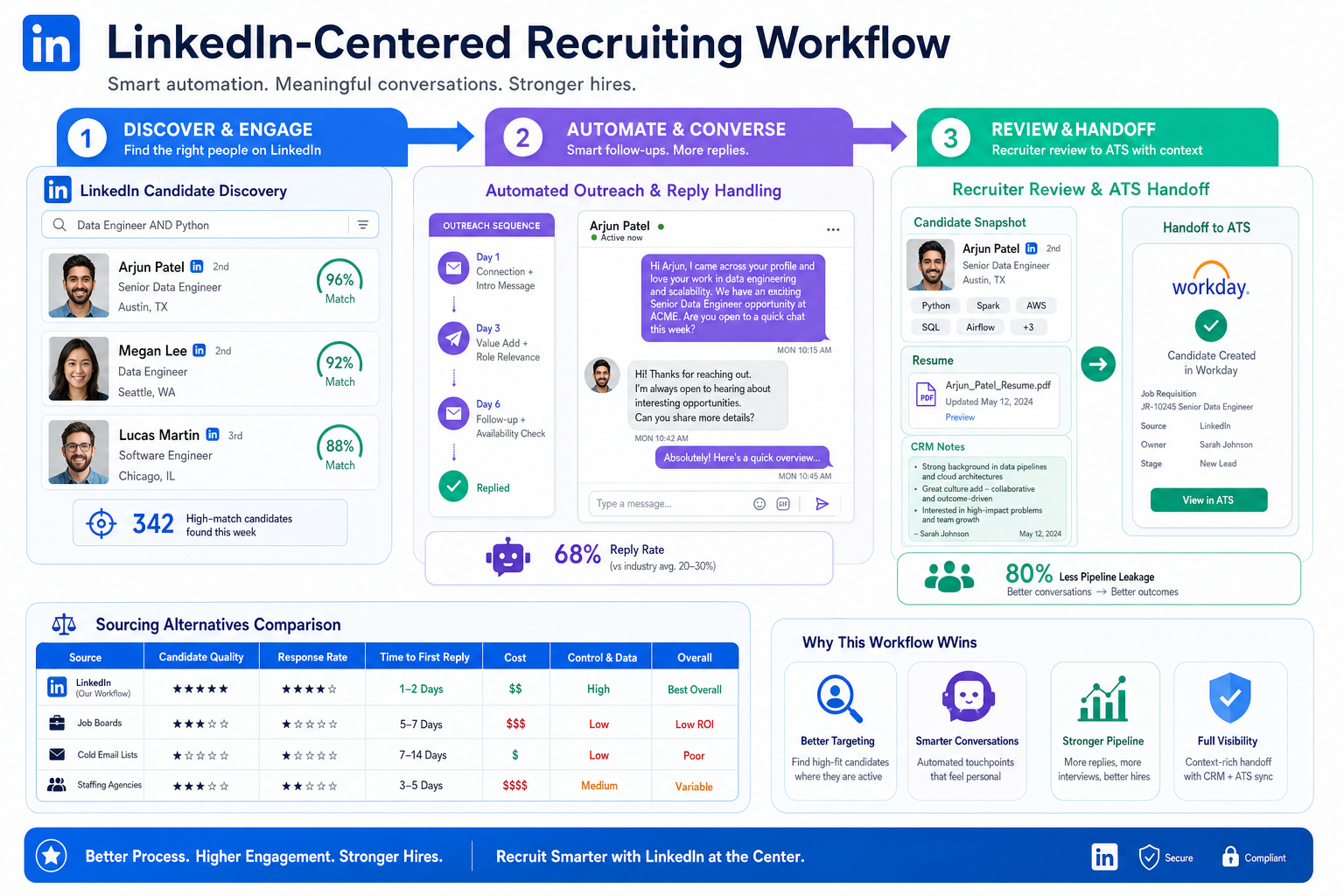
When sourcing stalls after first replies, this article helps recruiting leaders judge alternatives to LinkedIn for talent sourcing and avoid pipeline leakage.
The real pain is rarely just search volume. It is what happens after a recruiter finds someone promising and then loses momentum because follow-up is delayed, notes are scattered, hiring context is thin, or candidate interest fades before a human reply lands. For solo recruiters, that means wasted desk time and weaker submission flow. For agency owners, it creates uneven delivery and frustrated clients. For internal talent teams, it turns sourcing effort into pipeline leakage, employer-brand drag, and avoidable cost.
That is also where workflow support matters more than another profile list. In my own LinkedIn-heavy recruiting work, StrategyBrain AI Recruiter has been useful when the bottleneck is repetitive outreach and after-hours candidate conversation rather than final selection. It can keep initial LinkedIn contact moving, answer basic role questions, and collect resumes or contact details from interested people, while the recruiter still owns the judgment call on fit, resume review, and whether the person should move to interview.
A useful way to think about this comes from a familiar hiring reality: candidates do not choose opportunities on compensation alone. In accounting, for example, firms often compete on culture, growth, and whether the work feels connected to a bigger mission. When two employers look similar on paper, the difference is often whether the candidate can see meaningful work, manager support, and room to progress. Recruiters then have to do more than source names. They have to communicate the full picture clearly and consistently.
That is exactly where many teams discover the limits of a single sourcing seat. A recruiter identifies an accountant, sends a message, answers one reply, then gets pulled into another requisition before explaining how the role connects to the firm’s goals, what the team values, or why the environment supports development. The next step should be simple: continue the conversation, capture interest, log the interaction, and move the candidate forward. Instead, the process breaks. That gap is why buyers start looking at linkedin recruiter alternatives and, more specifically, the best alternatives to LinkedIn Recruiter for teams that need both discovery and reliable workflow.
Table of Contents
- Why teams look beyond LinkedIn Recruiter
- What counts as a real alternative?
- 1. Connect sourcing to the bigger hiring story
- 2. Create a baseline before switching tools
- 3. Set practical goals for your sourcing stack
- 4. Build a recruiter-friendly learning workflow
- Quick comparison by use case
- Best options by recruiting use case
- How to choose the right fit
- Common mistakes
- FAQ
Why teams look beyond LinkedIn Recruiter
Most teams researching alternatives to LinkedIn for talent sourcing are not trying to erase LinkedIn from the process. They are reacting to a workflow problem. The source may still be useful, but the system around it is not strong enough to support speed, context, and consistency.
That distinction matters. In practice, hiring breaks down when recruiters cannot do three things well at the same time:
- find people outside one familiar network,
- explain why the opportunity matters, and
- keep communication moving without manual follow-up gaps.
The reference point from culture-led hiring is helpful here. Candidates often evaluate an employer based on mission, growth, and daily experience, not just the title. So if your sourcing tool helps you find someone but your workflow does not help you communicate the bigger picture, you still lose the candidate.
What counts as a real alternative?
A LinkedIn Recruiter alternative can be a direct sourcing platform, a recruiter CRM, a talent intelligence system, an ATS-led recruiting suite, or an automation layer that supports outreach and response handling. The important question is not category purity. It is whether the tool solves the specific break in your process.
From experience, buyers usually fall into one of four groups:
- Search-depth buyers: They need broader candidate discovery beyond LinkedIn.
- Workflow buyers: They need help with response handling, message continuity, and recruiter time.
- Operations buyers: They need stronger ATS or reporting discipline.
- Hybrid buyers: They need some of all three.
That is why search intent around alternatives to LinkedIn for talent sourcing and best alternatives to LinkedIn Recruiter often overlaps. Some people want more profiles. Others need a better process after the first message goes out.
1. Connect sourcing to the bigger hiring story
One of the most useful lessons from culture-based recruiting is simple: connect the dots. If a candidate cannot see how the role fits the company’s goals, team environment, and growth path, sourcing quality alone will not carry the process.
For recruiters evaluating linkedin recruiter alternatives, this becomes a practical screening question:
- Can the platform help recruiters present role context consistently?
- Can it support ongoing conversation without losing momentum?
- Can it surface or preserve the information candidates actually use to judge an opportunity?
This is also where automation can help when used carefully. A tool such as StrategyBrain AI Recruiter can keep initial LinkedIn conversations active, especially after hours or across time zones, while the recruiter prepares the deeper human part of the pitch. In my experience, that works best when the role story is already clear. Automation is not a substitute for recruiter judgment. It is a support layer for speed and continuity.
Practical takeaway: if your team cannot explain why the job matters, no sourcing database will fully solve the problem. If your team can explain it but cannot do it consistently at scale, workflow support becomes far more valuable.
2. Create a baseline before switching tools
The culture article’s next useful idea is to establish a baseline before trying to improve anything. Recruiting leaders should do the same before buying a replacement or add-on.
Ask these questions first:
- Where do candidates come from today?
- How often do sourced candidates reply?
- How long does it take your team to answer interested candidates?
- Where are notes, resumes, and contact details being stored?
- Do recruiters lose time repeating the same first-stage conversations?
- Is the real issue sourcing reach, or is it follow-through?
Without this baseline, teams compare tools the wrong way. They focus on filters and seat cost while ignoring the actual process failure. In many environments, the problem is not that recruiters cannot find people. It is that they cannot maintain a clean, timely, contextual conversation with enough prospects at once.
That has been one of the more practical use cases for AI Recruiter in LinkedIn-based sourcing: keeping first-touch communication moving, capturing resume submissions, and reducing the dead time between a candidate reply and recruiter review. The recruiter still has to decide who is qualified, but the administrative lag drops.
3. Set practical goals for your sourcing stack
Once you understand the current state, define a short list of actionable goals. The reference article suggested narrowing improvement into a few concrete items. That same discipline works well here.
For most recruiting teams, the right goals sound like this:
- Increase candidate discovery beyond one channel.
- Reduce response lag in the first conversation.
- Improve handoff from sourcing to recruiter review or ATS stage.
Those goals are much more useful than vague plans to “upgrade sourcing.” They also help separate direct database tools from workflow tools. If goal one matters most, prioritize search breadth. If goal two matters most, prioritize automation and communication support. If goal three matters most, prioritize ATS and CRM connectivity.
This is the point where best alternatives to LinkedIn Recruiter should be judged by use case, not by brand familiarity.
4. Build a recruiter-friendly learning workflow
The final strong idea from the reference piece is the value of a teaching culture: teams improve when people share what is working, what is not, and how candidate conversations can be handled better over time.
That matters in sourcing technology too. A new platform fails when recruiters are left alone to invent their own process. Adoption improves when teams create:
- shared message standards,
- clear ownership for follow-up,
- simple feedback loops on candidate quality,
- manager coaching on outreach and positioning, and
- ongoing refinement based on what actually converts.
In other words, software does not just need features. It needs a working team habit around it. The strongest linkedin recruiter alternatives usually fit into a repeatable system where recruiters learn from outcomes and improve their approach instead of reinventing each search from scratch.
Quick comparison: alternatives by use case
| Type of option | Best for | How it differs from LinkedIn Recruiter | Best fit | Main watchout |
|---|---|---|---|---|
| Multi-source sourcing platforms | Broader passive candidate discovery | Searches beyond LinkedIn and often adds enrichment | Mid-market and enterprise sourcing teams | Can create noise if search discipline is weak |
| Recruiter automation on LinkedIn | Initial outreach, reply handling, and resume capture | Supports LinkedIn workflow rather than replacing the network itself | Agency recruiters, in-house teams, high-volume outbound users | Recruiter still needs to own qualification and fit |
| Recruiting CRM systems | Nurture, follow-up, and pipeline visibility | Stronger on process than on raw profile discovery | Outbound teams with structured campaigns | Not always enough as a stand-alone sourcing answer |
| ATS-first recruiting suites | Process control, compliance, reporting | Built around workflow consistency after sourcing | Larger HR organizations | May not solve top-of-funnel sourcing gaps by itself |
| Agency database systems | Rediscovery, speed-to-submit, desk productivity | Optimized for internal reuse and recruiter throughput | Staffing firms and search agencies | Less useful if your issue is external passive reach |
Best LinkedIn Recruiter alternatives by recruiting use case
1. When your issue is limited candidate discovery
If recruiters keep finding the same profiles, you likely need broader sourcing coverage. In that case, direct sourcing platforms and talent intelligence tools make more sense than workflow-only solutions.
Use this path if your team says:
- “We have too few relevant passive candidates.”
- “Our searches keep circling the same market.”
- “We need more technical, niche, or hard-to-find talent.”
Evaluate search precision, profile freshness, and whether the added database genuinely changes candidate quality.
2. When your issue is delayed outreach and weak reply handling
This is one of the most common reasons recruiters start exploring best alternatives to LinkedIn Recruiter. The problem is not finding people. It is that conversations stop between reply one and recruiter action.
That is where I have seen StrategyBrain AI Recruiter fit best. It is useful for teams that are already sourcing on LinkedIn but want help with repetitive first-touch messaging, ongoing responses, multilingual communication, and collecting resumes or contact details while the recruiter is offline. It does not replace final assessment. It protects momentum until the recruiter steps in.
That matters especially in agency settings, where after-hours replies often show up when a recruiter is working another desk, and in internal teams trying to maintain employer-brand consistency across multiple open roles.
3. When your issue is weak employer context
Some teams assume low response rates are purely a volume problem. Often they are a positioning problem. If candidates cannot quickly understand mission, growth, leadership style, or what makes the role meaningful, the outreach underperforms.
This is where the earlier culture lesson matters. The recruiter needs enough internal context to explain:
- how the role connects to company goals,
- why the team environment matters, and
- what development path the candidate can expect.
No tool can invent that on its own. But the right workflow can help recruiters deliver it more consistently.
4. When your issue is messy handoff into the hiring process
If recruiters source well but lose candidates because records are scattered, your real need may be ATS or CRM alignment. Look for systems that reduce duplicate data entry, preserve communication history, and keep candidate status visible across stakeholders.
This is particularly important in roles like accounting, finance, and other trust-heavy hiring environments where candidate questions often center on stability, management style, and long-term growth. The conversation itself becomes part of candidate evaluation, so the process around it must be organized.
5. When your issue is recruiter capacity
Solo recruiters and small teams often do not need a massive replacement platform. They need coverage. If the pain point is limited recruiter time, then automation on top of existing LinkedIn usage may offer more practical value than a full stack change.
That is a good example of why alternatives to LinkedIn for talent sourcing do not always mean abandoning LinkedIn. Sometimes the better answer is to keep the channel and improve the operating model around it.
How to choose the right fit for your team
Use this decision model before you buy:
| If your main problem is... | Prioritize... | Why it matters |
|---|---|---|
| Too few qualified passive candidates | Multi-source search breadth and filtering depth | Improves discovery beyond one ecosystem |
| Slow first-touch communication | LinkedIn workflow automation and reply continuity | Prevents candidate drop-off during early engagement |
| Candidates do not see the value of the role | Better recruiter messaging and employer-context capture | Supports culture and mission-based selling |
| Scattered process after sourcing | ATS or CRM integration | Keeps records, stages, and stakeholder handoff clean |
| Limited recruiter capacity | Time-saving workflow support | Lets recruiters focus on evaluation and closing |
| Agency desk speed | Database reuse and communication logging | Improves repeatability and speed-to-submit |
My advice is to test the tool against one live workflow, not a demo script. Take a real requisition, a real message sequence, and a real candidate handoff. That is how you find out whether the platform solves the actual break in your process.
Common mistakes when evaluating alternatives
Assuming the problem is only sourcing
Many teams blame LinkedIn search when the real issue is follow-through. If responses sit unanswered, no new database will fix the leak.
Ignoring the candidate’s decision logic
Candidates often compare culture, development, and meaning when compensation is similar. If your process cannot communicate that well, outreach performance suffers.
Buying software before establishing a baseline
Without knowing where the bottleneck sits, teams overbuy features and underinvest in process.
Letting automation replace recruiter judgment
Automation can help with continuity, but recruiters still need to assess fit, review resumes, and decide next steps. That line matters.
Failing to train the team
The best platform will underperform if recruiters have no shared outreach standards, no feedback loop, and no ownership model.
FAQ
Can anything fully replace LinkedIn Recruiter?
Sometimes, for a narrow workflow. Usually, no. Most teams are better served by combining broader sourcing, cleaner process, and better communication support rather than trying to force a full one-tool replacement.
What are the best alternatives to LinkedIn Recruiter for agency recruiters?
Agency recruiters often benefit most from tools that improve speed, follow-up continuity, and candidate rediscovery. If the desk already depends heavily on LinkedIn, workflow support can be as important as adding a new source.
What is the difference between sourcing alternatives and LinkedIn automation support?
Sourcing alternatives try to expand where you find talent. LinkedIn automation support helps you handle repetitive outreach and early-stage communication more efficiently inside an existing LinkedIn workflow.
Why does employer context matter in sourcing?
Because candidates often choose between similar offers based on culture, development, leadership, and meaningful work. Recruiters need systems that help them communicate those factors clearly.
Should small teams replace LinkedIn or build around it?
Usually build around it first. If the current issue is recruiter time, message continuity, or lost candidate replies, improving workflow may deliver more value than replacing the channel.
Final thoughts
The market for linkedin recruiter alternatives is really a market for better recruiting decisions. Some teams need broader search. Others need faster and more consistent communication. Others need a stronger system for turning candidate interest into real pipeline progress.
The most useful lesson from the culture-driven hiring lens is that recruiting works best when people can connect the dots: why the role matters, how the company operates, and what the candidate gains by engaging. The right tool should help you support that story, not interrupt it.
If you are comparing alternatives to LinkedIn for talent sourcing, start with the broken step in your current process. If it is search, buy search. If it is workflow, buy workflow. If your team already works heavily inside LinkedIn and keeps losing momentum after the first response, a support layer such as AI Recruiter can be a practical addition while recruiters stay in control of final screening, fit judgment, and hiring decisions.