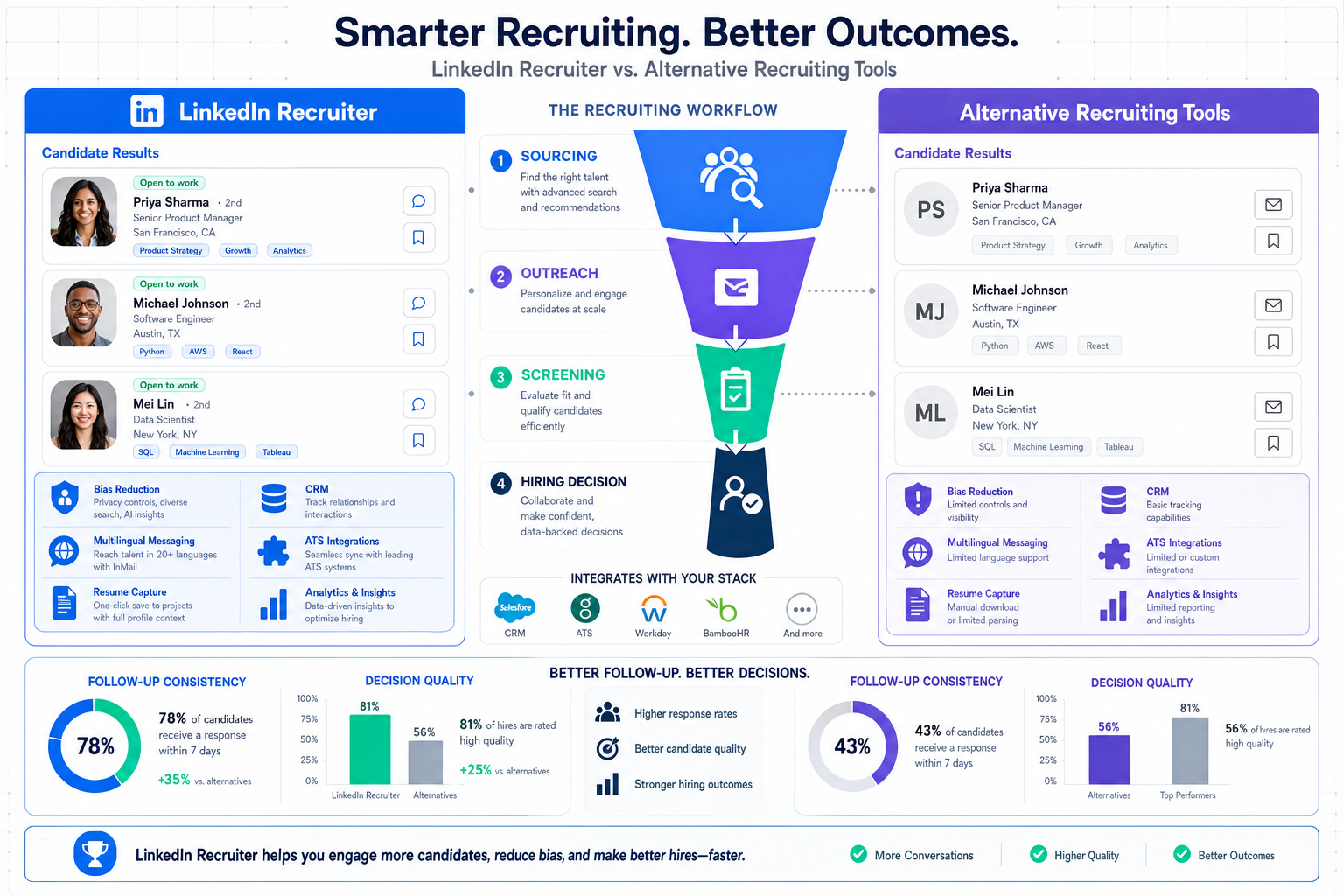
Use this article to compare linkedin recruiter competitors, tighten follow-up, reduce bias, and avoid weaker hiring decisions.
That usually becomes obvious only after a team starts missing follow-ups, relying too heavily on one dataset, or letting inconsistent screening habits shape who gets seen first. For a solo recruiter, that means lost response windows and more manual admin after hours. For a small agency owner, it means uneven delivery across consultants and weaker client trust. For in-house TA leaders, it can turn into a bigger risk: a hiring process that looks active on the surface but still leaves bias, poor documentation, and weak decision quality inside the funnel.
In my own LinkedIn-heavy recruiting work, one useful way to reduce that friction has been pairing human judgment with AI Recruiter for the repetitive front end of outreach. I have found it most helpful when recruiters need always-on candidate messaging, multilingual communication, and automated collection of resumes and contact details after initial interest is confirmed. That support does not replace recruiter judgment; the recruiter still decides who is actually qualified, reviews the resume, and owns the next-step conversation.
A useful frame for this comes from a behavioural-science discussion on hiring bias and inclusion that focused on the real mistakes hiring managers make, the limits of standard diversity efforts, and a practical framework for improving decisions. In that scenario, the problem was not simply finding more people. It was that the hiring team had to make choices under pressure, often with incomplete process discipline, while trying to improve diversity and avoid unconscious bias in a live hiring decision.
Once you look at linkedin recruiter alternatives through that lens, the software question changes. You are no longer asking only which tool finds profiles fastest. You are asking which system helps recruiters document outreach, widen the talent pool, create cleaner handoffs, and give hiring managers a more structured basis for decisions. That is where the best alternatives to LinkedIn Recruiter deserve a more serious comparison.
Table of Contents
- Why the Real Issue Is Not Just Sourcing
- At-a-Glance Comparison
- Where LinkedIn Recruiter Falls Short
- How to Evaluate Alternatives More Rigorously
- Three Types of LinkedIn Recruiter Competitors
- Where AI Recruiter Fits in a LinkedIn Stack
- Should You Replace or Supplement LinkedIn Recruiter?
- Common Mistakes When Comparing Tools
- Final Takeaway
- FAQ
Why the Real Issue Is Not Just Sourcing
The strongest lesson from behavioural-science thinking in hiring is simple: bias does not only show up in who appears in search results. It also shows up in how recruiters prioritize outreach, how hiring managers interpret candidate signal, and how loosely the team records decision steps. That matters when reviewing linkedin recruiter competitors because most teams start the search believing they need more sourcing power, while the deeper issue is often decision quality.
In practice, a team may reach enough candidates on LinkedIn and still struggle with fairness, consistency, and conversion. If outreach is scattered across InMail, email, spreadsheets, and recruiter memory, candidate treatment becomes uneven. If hiring managers review profiles without clear context, familiar backgrounds can keep winning. If notes are sparse, the process becomes harder to defend and harder to improve.
That is why experienced recruiters often compare alternatives based on three questions: does the tool broaden access to talent, does it make recruiter execution more consistent, and does it reduce the number of unstructured judgment calls in the funnel?
At-a-Glance Comparison
The market for linkedin recruiter alternatives is broad, but a shortlist gets clearer when you compare tools by the hiring problem you are actually trying to fix.
| Comparison Area | LinkedIn Recruiter Strength | What Competitors Often Emphasize | Best For |
|---|---|---|---|
| Sourcing inside LinkedIn | Direct access to LinkedIn profiles and familiar search behavior | Broader search beyond one professional network | Teams needing wider talent reach |
| Candidate outreach | InMail-led communication | Email sequencing, automated follow-up, response tracking | Recruiters doing high-volume outreach |
| Bias reduction support | Limited process structure around evaluation consistency | Better workflow discipline, richer records, more consistent candidate handling | Teams improving fairness and documentation |
| Technical hiring | Useful for profile discovery | Deeper technical filters and alternative talent signals | Engineering and specialist hiring teams |
| CRM and rediscovery | Basic pipeline support | Segmentation, nurture campaigns, candidate rediscovery | Teams building long-term pipelines |
| ATS alignment | May require extra handoffs | Stronger system-of-record workflows and cleaner stage management | Ops-minded TA teams |
| Seat economics | Can become expensive as usage expands | Different pricing models and modular stack choices | Lean teams and growing agencies |
A balanced takeaway is that credible linkedin recruiter competitors are often solving a broader workflow problem, not just trying to imitate LinkedIn profile access.
Where LinkedIn Recruiter Falls Short
Most teams do not look for alternatives because LinkedIn Recruiter has no value. They look because it creates downstream strain when used as the center of the stack.
1. It can widen top-of-funnel activity without improving decision quality
More sourcing volume is not the same as better hiring. If hiring managers still make inconsistent judgments, if recruiter notes are thin, or if the same profile patterns keep getting preferred, the team may be moving faster without getting more rigorous. This is one place where the behavioural-science angle matters: process design influences outcomes.
2. InMail is useful, but outreach can become fragmented
Once recruiters need structured follow-up, after-hours responses, multilingual communication, or resume capture outside LinkedIn, the workflow often spreads across tools. That creates admin burden and weakens candidate experience.
3. One dataset is rarely enough for every search
For technical, global, or highly specialized hiring, teams often want signals from outside LinkedIn alone. Depending on role type, broader sourcing may matter more than staying inside one familiar environment.
4. Hiring managers need a cleaner basis for judgment
The webinar context behind the reference piece highlighted common hiring-manager mistakes and the need for a more deliberate framework. That is highly relevant here. If recruiters cannot present organized outreach history, candidate context, and consistent records, managers are more likely to fall back on instinct and pattern matching.
How to Evaluate Alternatives More Rigorously
Before choosing among the best alternatives to LinkedIn Recruiter, define the hiring risk you are trying to reduce. In my experience, this produces better buying decisions than starting with a feature matrix.
Start with the decision problem, not the demo
Ask whether your issue is limited reach, slow outreach, inconsistent recruiter follow-through, poor candidate rediscovery, or weak manager visibility. Many teams think they need a sourcing replacement when what they really need is structure.
Check whether the tool supports more consistent candidate handling
If the product helps standardize first contact, capture resumes, preserve communication records, and move candidates into a cleaner review flow, it can indirectly support fairer hiring practices. This is not a small point. Consistency is often where bias reduction becomes operational rather than theoretical.
Review how it supports broader inclusion goals
The reference material stressed that typical diversity approaches can have drawbacks if they are not tied to a stronger decision framework. Software should help widen pools and improve documentation, but it should also fit the hiring team’s long-term goals, stakeholder context, and accountability model.
Test the manager handoff, not just the recruiter workflow
Good recruiting software should make it easier for hiring managers to review signal with context instead of relying on a quick skim or personal preference. That means cleaner records, better summaries, and fewer missing steps between sourcing and evaluation.
Three Types of LinkedIn Recruiter Competitors
Because this topic is software-focused, it helps to compare three recognizable categories of linkedin recruiter competitors rather than pretending every tool serves the same use case.
1. Broad sourcing platforms
Products in this category are usually evaluated for wider candidate discovery, stronger filtering, and access to talent signals beyond LinkedIn. Their advantages are search breadth and, often, better coverage for technical or niche roles. Their tradeoffs can include implementation complexity, learning curve, and additional cost if your real bottleneck is not top-of-funnel volume. They tend to fit larger in-house teams, search firms, and specialist recruiting functions. In a stack, they can work alongside AI Recruiter when the recruiter wants to source broadly but still automate repetitive LinkedIn conversations and resume collection inside a familiar channel.
2. Recruiting CRM platforms
These tools are usually strongest in nurture, segmentation, outreach measurement, and rediscovery of existing talent. The user experience is often better for recruiters running campaigns and maintaining longer-term relationships. The downside is that they may not fully replace a sourcing engine or an ATS. Cost can also rise as team size and workflow complexity increase. They fit talent teams that already have sourcing motion but need stronger middle-funnel discipline. Used well, they complement AI Recruiter by giving the team a better place to manage engagement history after initial LinkedIn conversations are handled.
3. ATS-led recruiting platforms
These are usually the right choice when the real issue is process control rather than profile discovery. Their strengths are structured stage movement, hiring-manager collaboration, approvals, reporting, and better data hygiene. Their weaknesses are that they may not solve proactive sourcing depth on their own, and setup can feel heavy for very small teams. They fit companies with repeatable hiring volume, compliance needs, or leadership pressure for cleaner reporting. In practice, they pair well with AI Recruiter when recruiters want LinkedIn outreach to keep running while the ATS remains the source of truth for final review and decisions.
I would avoid treating any of these categories as a universal winner. The better question is which combination removes the bottleneck that is making your process less fair, less efficient, or less reliable.
Where AI Recruiter Fits in a LinkedIn Stack
Since this topic is specifically about LinkedIn use, it is worth separating search software from LinkedIn execution software. In my own testing, StrategyBrain AI Recruiter is most relevant when the team still values LinkedIn as a sourcing channel but wants to reduce manual effort in the repetitive first-contact layer.
The advantage is not that it makes hiring decisions for you. It does not. What it can do is keep candidate communication moving around the clock, respond in the candidate’s language, introduce the role, check whether the person is open to talking, and collect resumes or contact details when there is interest. That is especially useful for agency recruiters, independent headhunters, and in-house teams covering multiple geographies or handling after-hours replies.
One lesson I learned quickly is that this kind of support is most effective when the recruiter is clear about the handoff line. I still review every interested profile, check the resume against the role, and decide whether the person should enter screening. In other words, automation can make the top of the funnel more consistent, but the quality bar still depends on human judgment.
That also connects back to the behavioural-science theme from the reference piece. Reducing bias in hiring is not just about good intentions. It depends on how well the process reduces random variation, missed context, and rushed judgment. A more reliable LinkedIn outreach workflow can help because it removes some of the chaos that often distorts later decisions.
Should You Replace or Supplement LinkedIn Recruiter?
In many real teams, the better answer is supplementation rather than full replacement.
Practical rule: Replace LinkedIn Recruiter when your team no longer gets enough value from LinkedIn-native sourcing. Supplement it when the bigger problem is outreach consistency, workflow structure, manager handoff, or candidate documentation.
A retained search recruiter might keep LinkedIn Recruiter for direct visibility but add CRM or automation support to handle scale and follow-up more consistently. A small agency may reduce manual load with AI Recruiter while keeping final shortlist judgment fully human. An in-house team trying to improve inclusion may invest more in ATS discipline and manager calibration than in another sourcing seat.
The point is not to chase a perfect replacement. It is to build a stack that supports both recruiter throughput and better hiring decisions.
Common Mistakes When Comparing Tools
- Confusing sourcing volume with hiring quality: More profiles do not fix weak evaluation habits.
- Ignoring bias-related workflow issues: If records are inconsistent, decision-making often becomes less fair and less defensible.
- Buying for recruiters only: Hiring managers also need clearer context and more structured input.
- Overlooking after-hours and multilingual realities: Global recruiting often breaks down in follow-up, not just in search.
- Expecting automation to replace judgment: Strong tools support recruiter execution; they do not remove the need for review and selection.
Final Takeaway
The search for linkedin recruiter alternatives should start with a tougher question than feature comparison: what part of your hiring process is making good decisions harder? The behavioural-science lens from the reference piece is useful here because it reminds us that bias, inconsistency, and weak process design are often the deeper issue.
If LinkedIn Recruiter still gives your team strong access to the right people, keep that value in view. But if your recruiters are losing time in repetitive outreach, if managers are reviewing candidates without enough structure, or if process consistency is slipping, then linkedin recruiter competitors may offer a better fit in sourcing breadth, CRM discipline, ATS control, or LinkedIn automation support.
The best alternatives to LinkedIn Recruiter are not always the ones with the longest feature list. They are the ones that help your team widen access, reduce manual friction, and make hiring decisions with better evidence and less noise.
FAQ
What are the best alternatives to LinkedIn Recruiter?
The best alternatives to LinkedIn Recruiter depend on your main bottleneck. If you need broader search coverage, look at sourcing-focused platforms. If you need better outreach and nurture, compare recruiting CRM tools. If your issue is workflow control, an ATS-led platform may be the better move.
Are linkedin recruiter competitors only for large teams?
No. Small agencies, solo headhunters, and growing in-house teams often benefit the most when they reduce manual outreach work and improve process consistency. The right stack depends more on workflow maturity than on company size alone.
Should I replace LinkedIn Recruiter or use it with another tool?
Many teams get more value by combining LinkedIn Recruiter with another tool. That second layer might provide CRM workflows, ATS structure, or LinkedIn automation support such as multilingual messaging and resume capture, while recruiters keep final decision control.
Can automation help reduce bias in hiring?
Automation cannot eliminate bias by itself, but it can support more consistent outreach, better documentation, and cleaner handoffs. Those process improvements can reduce the amount of random, unstructured decision-making in the funnel.
Where does AI Recruiter fit among linkedin recruiter competitors?
It fits best for teams that still rely on LinkedIn but want to automate repetitive first-contact work. It can support always-on communication, multilingual outreach, and resume collection, while the recruiter still handles qualification, evaluation, and interview decisions.