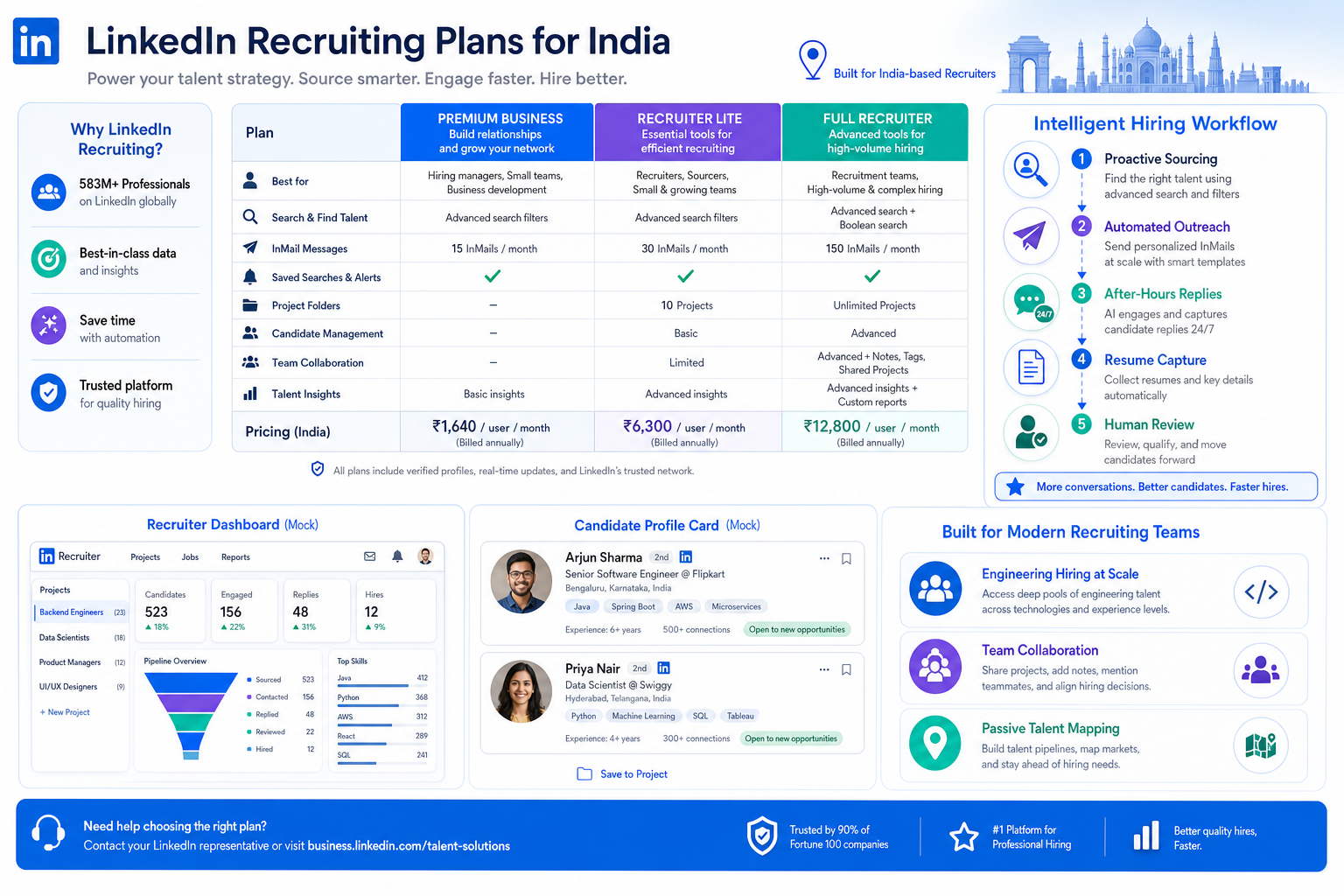
When hiring demand grows, this article helps India-based recruiters judge recruiter linkedin licence cost india, avoid mismatched plans, and fix reactive sourcing bottlenecks.
The mistake I see most often is treating LinkedIn access as the full recruiting answer when the real pressure sits elsewhere: delayed follow-up with passive candidates, inconsistent outreach across open roles, weak handoff to hiring managers, and no reliable way to stay ahead of future hiring demand. That hurts small agencies, solo recruiters, and in-house talent teams differently, but the outcome is similar: more manual work, slower response times, and more missed talent in candidate-short markets.
That is also why I have become more practical about AI Recruiter as a support layer inside LinkedIn workflows. In my own testing, the value was not in replacing recruiter judgment. It was in handling repetitive first-touch outreach, after-hours candidate replies, and early interest capture so I could spend my time reviewing resumes, checking fit, and deciding who should move forward. In shortage markets, that kind of workflow support matters more than another generic seat upgrade.
The clearest example comes from hard-to-fill engineering hiring, where demand keeps rising, specialist shortages stay persistent, and retirement-driven supply pressure makes talent planning harder every year. In that environment, recruiters cannot wait for a plant expansion, a project launch, or a senior engineer’s resignation before they start sourcing. They need to assess what skills exist internally, compare that against what will be needed next year, and start building relationships with passive candidates long before a requisition becomes urgent.
Once you work that way, the LinkedIn plan question changes. You are no longer asking only how much is LinkedIn in the abstract. You are asking whether Premium Business is enough for occasional visibility, whether Recruiter Lite can support proactive talent mapping, and whether full Recruiter is justified when candidate pipelines, outreach volume, and team coordination begin to look more like a sustained recruiting operation than a one-off search.
If you are researching linkedin recruiting automation, that is the right frame to use. The real buying decision is not just about access to LinkedIn. It is about whether your sourcing motion is reactive or proactive, whether your market behaves like engineering and other talent-short sectors, and whether your team needs deeper recruiting workflow support than a general business subscription can offer.
Table of Contents
- Why recruiter linkedin licence cost india gets confusing
- How talent-short markets change the buying logic
- How much is LinkedIn by plan type
- LinkedIn Premium Business vs Recruiter Lite
- When full Recruiter makes sense
- Where LinkedIn recruiting automation actually helps
- Three other tools buyers often compare
- How I evaluate the upgrade path in practice
- Common buying mistakes
- FAQ
Why recruiter linkedin licence cost india gets confusing
In practice, this search usually bundles together three different questions:
- What does LinkedIn show publicly for Premium plans?
- How should I compare that against Recruiter Lite?
- What happens when my team needs full Recruiter, which is often sold through a quote-led process?
That is why the phrase recruiter linkedin licence cost india can be misleading if you expect one fixed answer. India-based buyers also have to account for billing region, currency display, taxes, mobile versus desktop checkout paths, and occasional promotions. A responsible cost discussion should acknowledge those variables instead of pretending one screenshot equals a universal list price.
From a recruiter’s perspective, the more useful distinction is this: public pricing is mainly an orientation tool, while recruiting-product pricing is usually part of a workflow decision. Once your team needs shared projects, higher outbound volume, stronger search depth, or more formal automation, the price discussion stops being a simple subscription lookup and starts becoming an operating-model decision.
How talent-short markets change the buying logic
The engineering hiring example matters because it shows why plan choice should be tied to market conditions, not just to visible pricing. In candidate-led sectors, waiting until a vacancy opens is already too late. The better recruiters are mapping skills early, keeping passive talent warm, and moving quickly when a project, relocation, or retirement suddenly creates demand.
That logic applies well beyond engineering. Any market with scarce skills, faster compensation movement, or growing reliance on project-based and contract talent creates the same sourcing problem: recruiters need tools that support preparation before urgency. That is one reason many teams eventually outgrow light-touch LinkedIn usage. They start needing consistent search, repeatable outreach, and a better system for handling replies when candidates respond outside business hours.
I found that AI Recruiter was most helpful in exactly those proactive situations. It can automate first-contact messaging, continue conversations across time zones, and collect resumes or contact details from interested candidates, while the recruiter still owns fit assessment and next-step decisions. That makes it relevant for agencies, corporate recruiters, and independent headhunters who are spending too much time on repetitive LinkedIn admin and not enough time on market judgment.
Practical takeaway: In a talent-short market, the best LinkedIn plan is the one that supports earlier sourcing, faster response, and cleaner follow-through—not just the cheapest visible seat.
How much is LinkedIn by plan type
When people ask how much is LinkedIn, they are often mixing business networking plans with recruiter-oriented products. The cleanest way to understand the buying path is to separate public pricing visibility from recruiting depth.
| Plan type | Pricing visibility | Best fit | What to watch |
|---|---|---|---|
| Premium Business | Usually publicly visible | Founders, operators, occasional hiring, business research | Not designed as a full recruiting workflow |
| Recruiter Lite | More recruiting-oriented entry path | Solo recruiters, small agencies, focused SMB hiring | Can feel limiting as hiring volume grows |
| Recruiter | Commonly quote-based | Larger teams, higher volume, deeper collaboration | Needs a stronger process to justify the spend |
This is why I advise clients not to anchor too hard on the first price they see. Premium Business may be the easiest benchmark, but that does not make it the right benchmark for serious sourcing work. A business networking subscription and a recruiting workflow seat are solving different jobs.
LinkedIn Premium Business vs Recruiter Lite
The comparison between linkedin premium business vs recruiter lite matters most for smaller teams because both can look like reasonable middle-ground choices.
Where Premium Business works
Premium Business is easier to understand from a public pricing perspective and can be enough if your hiring is infrequent, founder-led, or mixed with broader business development. It gives better visibility than a basic account, but it is still not primarily built around recruiter workflows.
Where Recruiter Lite works
Recruiter Lite is the more natural fit when candidate sourcing is a regular part of your week. If your day involves finding niche talent, contacting passive prospects, and managing reply volume role by role, Lite usually aligns better than trying to force a networking plan into a recruiting use case.
Side-by-side view
| Decision factor | Premium Business | Recruiter Lite |
|---|---|---|
| Main use case | Networking and business visibility | Entry-level recruiting and sourcing |
| Public price clarity | Higher | Less often used as a broad benchmark |
| Search intent | General professional lookup | Recruiter-oriented search |
| Outreach fit | Relationship building | Candidate outreach |
| Best buyer | Occasional hirer | Working recruiter or small talent team |
In real usage, the differences usually show up in search precision, recruiter-friendly filtering, messaging capacity, and whether the product supports the rhythm of active sourcing instead of general networking. If you are handling hard-to-fill roles repeatedly, that distinction matters quickly.
My own rule is simple: if you are mostly observing the market, Premium Business may be enough; if you are repeatedly building pipelines, Recruiter Lite is usually the more honest fit.
When full Recruiter makes sense
Full Recruiter tends to become relevant when your team is no longer just sourcing occasionally but running a coordinated recruiting motion across several roles, recruiters, or geographies.
Typical signals include:
- Multiple recruiters need shared access
- Passive talent mapping is continuous, not occasional
- Hiring managers want stronger visibility into search progress
- Search precision matters because roles are highly specialized
- Response handling and follow-up are becoming operational bottlenecks
- You need a sourcing layer that connects cleanly with the rest of recruiting operations
At that point, the question is no longer just how much is LinkedIn. It becomes:
- How many seats will we truly use well?
- How much recruiter time is being lost to repetitive sourcing work?
- Which roles are expensive to leave open?
- How much collaboration and governance do we need?
- Can the team actually absorb more top-of-funnel activity?
Those questions are especially important in India, where teams often try to stretch a lighter setup longer than they should. Sometimes that is sensible. Sometimes it creates hidden cost through recruiter time loss and slower candidate movement.
Where LinkedIn recruiting automation actually helps
There is a lot of vague talk around linkedin recruiting automation, so I prefer to narrow it down to the tasks that genuinely consume recruiter time without requiring recruiter judgment.
The most realistic use cases are:
- Initial outreach to candidates who match defined search criteria
- Fast replies to candidate questions outside recruiter working hours
- Consistent follow-up with prospects who show interest
- Capturing resumes and contact details for human review
- Supporting multilingual communication when hiring across markets
That is why I found AI Recruiter useful as a LinkedIn support tool rather than as a replacement for recruiting craft. It can keep outreach moving, answer common role questions, and gather contact information from interested candidates, but the recruiter still decides whether the resume fits, whether the conversation should continue, and whether the candidate belongs in the shortlist.
For headhunters and lean internal teams, that division of labor is practical. The software handles repetitive communication; the recruiter handles credibility, qualification, compensation judgment, and client or hiring-manager alignment.
Three other tools buyers often compare
When teams evaluate LinkedIn-centric recruiting automation, they often compare more than one platform. Based on common market visibility, three names that tend to come up are LinkedIn Recruiter, HeroHunt, and Skylead. Their fit differs quite a bit depending on how recruiter-led the workflow is.
| Tool | Usage experience | Expected effect | Cost approach | Best for | How it can work alongside AI Recruiter |
|---|---|---|---|---|---|
| LinkedIn Recruiter | Native recruiting workflow inside LinkedIn | Strong search and sourcing depth | Typically premium and often sales-led | Larger recruiting teams, specialist searches | AI Recruiter can support repetitive outreach and response handling around the sourcing workflow |
| HeroHunt | Often considered by teams exploring outbound automation | Can support prospecting-style activity | Varies by package and use case | Teams testing automation layers | AI Recruiter is stronger when the goal is recruiter-style candidate conversation and resume capture on LinkedIn |
| Skylead | Known in multichannel outreach circles | Useful for sequence-based outreach patterns | Subscription-based evaluation | Outbound-heavy users, sales-style operators | AI Recruiter fits better when the workflow needs recruiting-specific role conversations rather than generic sequence logic |
I would not present these as perfect one-to-one substitutes, because they are not. The main difference is workflow intent. Recruiters hiring for scarce talent usually need candidate-specific dialogue, resume collection, and handoff to human review. That is where AI Recruiter stands out as a support layer built around recruiter activity rather than general outbound sequencing.
How I evaluate the upgrade path in practice
When I help a team choose between Premium Business, Recruiter Lite, and full Recruiter, I usually use the same decision path that shortage markets force on engineering hiring: plan ahead, recruit passive talent, and make sure your process can move fast enough to win.
1. Start with future demand, not current panic
If you know new projects, expansion, or attrition are coming, price the LinkedIn plan against future sourcing intensity rather than today’s lowest possible spend. Reactive buying creates false economies.
2. Measure passive-candidate dependence
The more your roles depend on candidates who are already employed, the less useful a general networking seat becomes. Passive talent recruiting usually pushes teams toward recruiter-oriented workflows.
3. Check whether speed is your true bottleneck
If your team loses candidates because replies arrive at night, follow-up is inconsistent, or outreach stalls between open roles, automation support may matter more than another manual search seat.
4. Separate access from execution
More profile access does not automatically create a better recruiting process. If the team cannot track conversations, gather resumes consistently, or hand off interested candidates cleanly, the visible subscription cost is only part of the picture.
5. Upgrade only when collaboration complexity demands it
Full Recruiter is easiest to justify when recruiting has become a team sport with real coordination needs. If you are still operating as a focused solo recruiter, Lite plus smart workflow support may be enough.
Common buying mistakes
Using Premium pricing as the answer to every cost question
Visible pricing is helpful, but it does not resolve how recruiting seats are sold or whether they fit your hiring model.
Buying for occasional hiring when the market requires continuous sourcing
Candidate-short functions do not reward reactive workflows. If your market behaves like engineering, proactive sourcing should shape your tool choice.
Overvaluing search access and undervaluing response handling
Many recruiters can find talent. Fewer can keep outreach moving consistently at scale. That is where automation support can create operational relief.
Trying to replace recruiter judgment with software
No serious recruiter should outsource final fit assessment. Tools can support outreach and information capture, but resume review, stakeholder alignment, and shortlist decisions remain human work.
Ignoring the next workflow stage
If candidate flow improves, your process must absorb it. Otherwise, top-of-funnel efficiency simply creates downstream delay.
FAQ
What does recruiter linkedin licence cost india usually refer to?
It usually refers to a mix of Premium pricing, Recruiter Lite comparisons, and full Recruiter budgeting. Those are not the same buying path, especially for India-based teams dealing with regional billing and tax differences.
How much is LinkedIn for a recruiter?
That depends on which LinkedIn product you mean. Premium Business is often the easiest public reference point, Recruiter Lite is more recruiter-oriented for smaller setups, and full Recruiter is commonly handled through a sales conversation.
Which is better: LinkedIn Premium Business vs Recruiter Lite?
If you hire occasionally, Premium Business may be enough. If sourcing candidates is a recurring recruiter task, Recruiter Lite is usually the better fit because it is closer to the actual job to be done.
When should I upgrade from Lite to full Recruiter?
Usually when search volume, seat count, collaboration needs, or specialization level make a solo-style workflow too limiting. The upgrade is easier to justify when recruiting becomes an organized team function.
Where does automation fit into LinkedIn recruiting?
Automation fits best in repetitive communication tasks such as first outreach, follow-up, after-hours response, and collecting resumes or contact details from interested candidates. Recruiters should still own qualification and final decisions.
Is AI Recruiter useful for agencies as well as in-house teams?
Yes. It is relevant anywhere recruiters spend too much time on repetitive LinkedIn conversations. Agencies, solo headhunters, and internal talent teams can all benefit when the tool is used to support workflow speed rather than replace recruiter judgment.
Conclusion
If your search begins with recruiter linkedin licence cost india, the most useful answer is rarely a single number. The smarter approach is to match your LinkedIn spend to the kind of market you recruit in, the amount of passive sourcing you depend on, and the operational maturity of your workflow.
Use public pricing to orient yourself on how much is LinkedIn, compare linkedin premium business vs recruiter lite based on actual recruiting behavior, and move toward full Recruiter only when hiring volume and collaboration needs justify it. In tighter talent markets, especially those that behave like engineering, proactive sourcing and faster response often matter more than the cheapest visible plan.
And if the real bottleneck is repetitive LinkedIn work, not recruiter judgment, then a support layer such as AI Recruiter can help keep conversations moving while recruiters stay focused on fit, resumes, and hiring decisions.