Treating websites like LinkedIn as interchangeable can hurt shortlist quality and retention, so this article helps recruiters match each option to the right hiring stage.
The costly mistake is treating every alternative as another place to post jobs. In practice, channel mismatch shows up later as weak applicant quality, delayed shortlists, confused candidate expectations, poor handoff into onboarding, and avoidable attrition that hiring teams wrongly blame on sourcing alone.
When I need to keep LinkedIn outreach moving without losing control of judgment, I use StrategyBrain AI Recruiter for the repetitive front end: connecting with relevant candidates, answering routine role questions, and collecting resumes or contact details from interested people. It helps most when response windows are short or global time zones make follow-up uneven, but the recruiter still owns final resume review, fit assessment, and next-step decisions.
The reason this matters goes beyond application volume. A candidate does not start evaluating your company at the interview stage; that judgment begins earlier, at attraction and first contact. If the role feels vague, the outreach feels late, or the handoff from interest to screening is messy, good people often disappear before anyone logs the loss correctly.
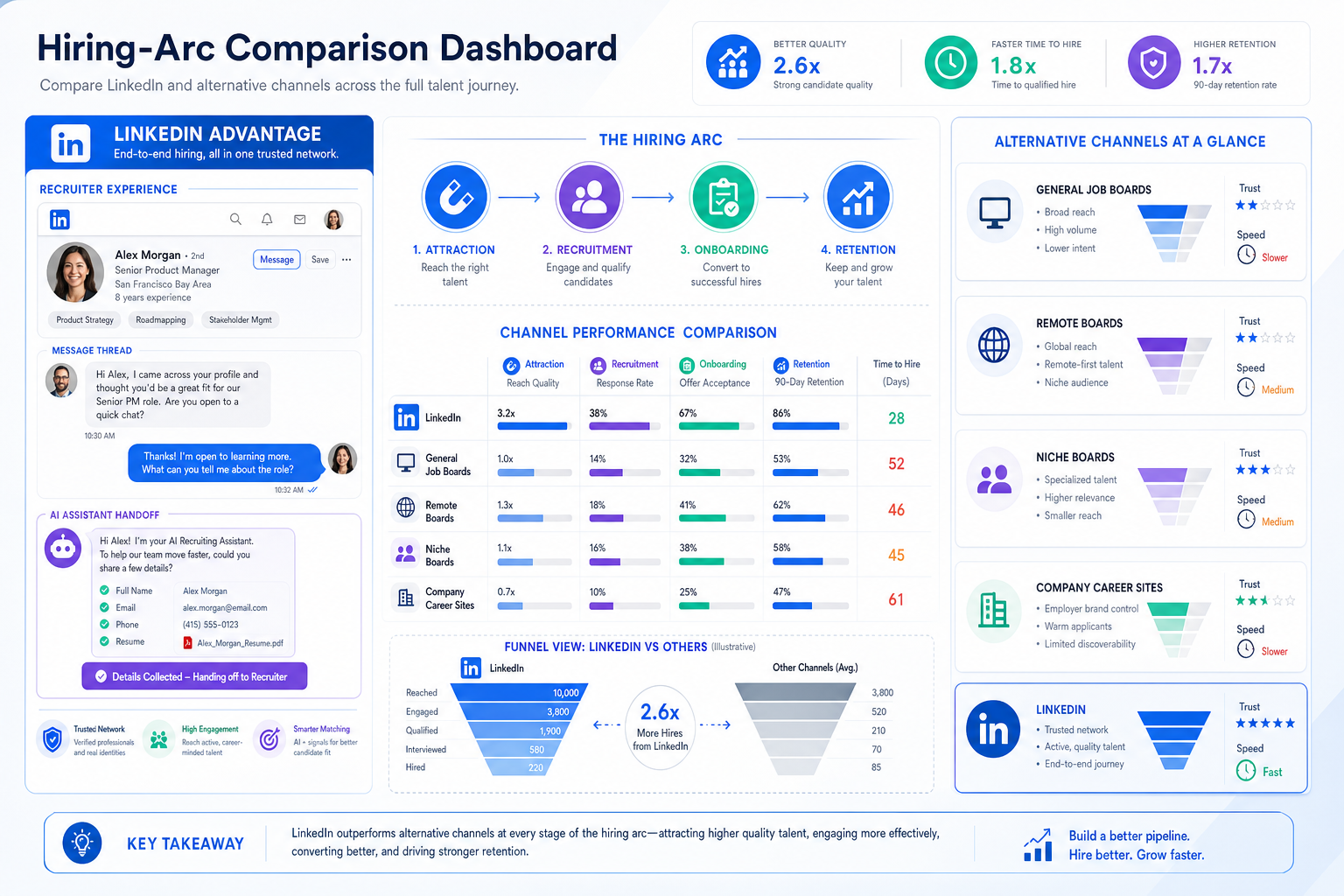
That is also why the search for sites like LinkedIn is more complex than it looks. You are not only comparing networks and job boards other than LinkedIn; you are deciding which channels support attraction, recruitment, onboarding expectations, long-term engagement, and retention. The best alternative depends on which part of that hiring arc is under strain.
Table of Contents
- Why LinkedIn alternatives need context
- A better framework: match channels to the hiring arc
- Quick comparison of LinkedIn alternatives
- Professional networking platforms
- Job boards other than LinkedIn
- Remote job websites
- Niche job boards
- Company career sites
- How I use StrategyBrain AI Recruiter in the mix
- How to choose the right alternative
- Practical tips for hiring teams
- FAQ
Why LinkedIn Alternatives Need Context
Experienced recruiters know LinkedIn is rarely the whole hiring system. It is strongest for professional identity, recruiter visibility, passive talent discovery, and warm outreach. But people searching for websites like LinkedIn often mean very different things: a place to network, a place to apply faster, a better remote filter, lower-competition niche listings, or a cleaner route into employer career pages.
The useful shift is to stop asking, "What replaces LinkedIn?" and start asking, "Which part of the hiring relationship am I trying to improve?" That idea comes from a broader people-operations truth: attraction affects recruitment, recruitment affects onboarding, onboarding affects engagement, and engagement influences retention. When a hire fails later, the cause often started much earlier.
That same logic applies to sourcing channels. A bad first-contact experience can hurt interview conversion. A vague listing can create poor-fit applications. A clumsy transition from message reply to resume submission can waste strong candidate intent. So the best sites like LinkedIn are the ones that support the specific stage where your process is weak.
A Better Framework: Match Channels to the Hiring Arc
Instead of grouping all LinkedIn alternatives together, I use a hiring-arc framework with five practical questions.
- Attraction: Where will the right candidate first notice and understand the opportunity?
- Recruitment: Which channel gives the clearest path from interest to screening?
- Onboarding signal: Does the application experience match how organized the company actually is?
- Engagement fit: Does the channel attract people who understand the work style, pace, and expectations?
- Retention signal: Are we bringing in candidates whose expectations are likely to match reality?
This framework is useful because many job boards other than LinkedIn outperform LinkedIn at one stage but not another. A remote board may be better for expectation-setting. A niche board may be better for relevance. A career page may be better for accuracy. A networking platform may be better for trust.
Practical takeaway: A sourcing channel should be judged by the stage it improves, not by whether it looks like LinkedIn.
Quick Comparison of LinkedIn Alternatives
| Alternative type | Best for | Usually stronger than LinkedIn at | Usually weaker than LinkedIn at |
|---|---|---|---|
| Professional networking platforms | Relationship-led hiring | Trust, referrals, focused communities | Universal profile reach |
| General job boards | Broad active job search | Search filters, application speed, job volume | Recruiter messaging and profile depth |
| Remote job boards | Distributed and flexible work | Remote clarity, work-style fit | Local or hybrid role breadth |
| Niche job boards | Specialized roles | Relevance, lower noise, domain fit | Total listing volume |
| Company career sites | Direct employer applications | Freshness, official process, job accuracy | Cross-company browsing |
| Freelance and project marketplaces | Contract hiring | Short-cycle matching, deliverable focus | Traditional long-term networking |
1) Professional Networking Platforms
Among all sites like LinkedIn, networking-oriented communities are the closest substitute when the role depends on credibility, referrals, and professional reputation.
Best for
- Executive and senior hiring
- Consulting, partnerships, and business development roles
- Passive candidate outreach
- Niche communities where reputation carries weight
What they do well
- Create warmer first contact
- Support context-rich introductions
- Help candidates assess the organization before applying
Where they fall short
- Lower direct application volume
- Less efficient for urgent pipeline building
- Inconsistent role-search experience compared with boards
Use this category when trust is part of qualification. In those situations, the channel does not just produce applicants; it shapes the candidate's view of whether the employer feels credible and understandable from the outside.
2) Job Boards Other Than LinkedIn
For many searchers, websites like LinkedIn really means job boards other than LinkedIn. That usually signals active intent: find open roles, filter fast, and apply without the extra social layer.
Best for
- High-volume hiring
- Mainstream functional roles
- Candidates who want clear search-and-apply workflows
- Recruiters who need immediate applicant flow
What they usually do better
- Simpler application flow
- Clearer location and experience filters
- Better support for active seekers than passive discovery
What they usually do worse
- Less profile-based networking
- Fewer relationship signals before application
- More variable applicant quality when roles are broad
In day-to-day recruiting, these boards often win on speed but lose on context. That tradeoff is acceptable when the role is common, the funnel is structured, and the team can screen quickly.
3) Remote Job Websites
Remote boards deserve separate treatment because they solve a different hiring problem: expectation match. Candidates using them are not just looking for another network. They want clarity on location rules, time zones, async work, and flexibility.
Best for
- Remote-first companies
- Digital roles with broad geographic reach
- Candidates prioritizing flexibility
- Recruiters reducing confusion around hybrid versus remote labels
Advantages
- Better remote-specific filtering
- Clearer work-style expectations
- Higher alignment for distributed teams
Limitations
- High competition for fully remote roles
- Smaller total universe than broad boards
- Overlap with direct employer listings
From a retention point of view, these channels matter because they reduce expectation drift. People leave when reality does not match what they thought they were accepting. Remote-specific channels can narrow that gap.
4) Niche Job Boards
Some of the best LinkedIn alternatives are not broad platforms at all. They are focused boards built around an industry, role family, mission type, or level of expertise.
Best for
- Technical and specialist hiring
- Creative and portfolio-based roles
- Research, nonprofit, or mission-driven work
- Candidates trying to avoid crowded mainstream listings
Why they work
- Lower noise from poor-fit applicants
- Stronger domain language and expectations
- Better odds that candidates understand the work before they apply
Tradeoffs
- Smaller audience
- Less useful for generic hiring
- Variable employer-branding tools
If the role requires shared vocabulary, portfolio norms, or industry fluency, niche boards often outperform larger sites like LinkedIn simply because they pre-qualify attention.
5) Company Career Sites
Direct career pages remain one of the most overlooked alternatives. They are especially valuable when syndicated listings become stale, duplicated, or stripped of context.
Why they matter
- Listings may appear there first
- The role description is usually most accurate
- The application path is official
- Candidates can assess team structure, values, and operating style in one place
Best for
- Candidates targeting a shortlist of employers
- Recruiters benchmarking competitor hiring patterns
- Hiring teams that care about expectation-setting from the start
Career sites matter for more than freshness. They connect attraction to onboarding better than most third-party channels because the candidate sees the employer's own language, structure, and priorities before applying.
6) Startup, Freelance, and Executive Options
Some roles need their own ecosystem.
Startup roles
Startup-focused communities are helpful when speed, ambiguity tolerance, and work style matter as much as title progression.
Freelance work
Project marketplaces are often better than broad job boards other than LinkedIn when hiring revolves around deliverables, start dates, and scoped contracts.
Executive search
Executive hiring still leans heavily on referrals, confidential outreach, and tightly networked talent pools. In that context, LinkedIn supports visibility, but it rarely carries the whole search.
How I Use StrategyBrain AI Recruiter in the Mix
My own use case for StrategyBrain AI Recruiter is straightforward: I do not use it to replace recruiter judgment, and I do not treat it as a magic sourcing shortcut. I use it where LinkedIn work becomes repetitive and timing-sensitive.
For example, when a role depends on rapid first contact, after-hours candidate replies, or multilingual communication, the tool helps maintain continuity. It can introduce the opportunity, handle routine candidate questions about the role or company, and keep follow-up moving while I focus on resume evaluation, shortlist quality, and stakeholder alignment. That is especially useful when candidates respond outside local office hours or across regions where a delayed reply quietly kills momentum.
I also like it for early-stage intake discipline. If a candidate is genuinely interested, the workflow can collect resume and contact details so that I am not chasing basic information across scattered message threads. You can review more on the setup process or see how the vendor explains the LinkedIn recruiting use case.
Where it fits best in this article's framework is the attraction-to-recruitment handoff. That is the stage where interest turns into commitment, and it is also where many teams lose good candidates through slow messaging, inconsistent follow-up, or unclear next steps. The software helps stabilize that handoff, but the recruiter still decides who is qualified and what happens next.
How to Choose the Right Alternative
The best alternative depends on the problem you need to solve.
| If your priority is... | Best category | Reason |
|---|---|---|
| Relationship building | Networking platforms | Better trust and referral dynamics |
| Fast active applications | General job boards | Cleaner search and apply flow |
| Remote clarity | Remote job websites | Stronger expectation setting |
| Specialized relevance | Niche job boards | Higher fit, lower noise |
| Official employer path | Company career sites | Fresh, accurate listings |
| Project or contract work | Freelance marketplaces | Deliverable-based matching |
For candidates, I usually recommend one network source, one broad application source, and one niche or direct-employer source. For recruiters, the same logic applies. One channel rarely supports every stage well.
Practical Tips for Recruiters, HR Teams, and Hiring Managers
1. Separate attraction from application flow
A networking channel and a job board should not be measured the same way. One creates familiarity and trust; the other drives submissions.
2. Audit where candidates actually disappear
If interest is high but resumes are low, the issue may be the handoff. If applications are high but interviews are weak, the issue may be positioning or channel fit.
3. Use the hiring arc as a channel scorecard
Ask whether the platform improves attraction, recruitment, expectation-setting, engagement fit, or retention likelihood.
4. Build a lower-competition lane
Niche boards and direct career pages can uncover openings and audiences that broad channels blur together.
5. Protect response speed on LinkedIn
If LinkedIn remains part of your mix, keep first-touch momentum strong. This is where a tool like AI Recruiter can help with candidate replies and information capture while the recruiter keeps control of evaluation and interview movement.
Common Mistakes to Avoid
Treating all LinkedIn alternatives as interchangeable
They are not. A network builds trust, a board drives volume, a niche source improves relevance, and a career page improves accuracy.
Blaming late-stage turnover on sourcing alone
Sometimes the real problem started at attraction or early recruitment, when the role was unclear or the process signaled poor organization.
Ignoring the onboarding signal inside the application experience
Candidates judge how a company operates long before they start. A messy process suggests a messy team.
Overloading recruiters with manual follow-up
Slow replies and scattered conversations weaken strong channels. That is often where supportive automation on LinkedIn helps most.
FAQ
What is the best alternative to LinkedIn?
There is no single best option. The right alternative depends on whether you need networking, faster applications, remote-role clarity, niche targeting, or direct employer access.
Are there job boards better than LinkedIn?
Yes. Many job boards other than LinkedIn are better for active search, filtering, and direct applications. LinkedIn is usually stronger for visibility and outreach.
What sites are like LinkedIn for networking?
Sites like LinkedIn for networking are usually professional communities where credibility, referrals, and industry conversation matter more than application volume.
Where should I apply besides LinkedIn?
Use a mix: broad job boards, remote or niche boards where relevant, and direct company career sites for the most accurate application path.
Why do some LinkedIn alternatives work better for retention?
Because they set expectations more clearly. Channels that accurately reflect work style, role scope, and employer reality reduce mismatch later.
How does StrategyBrain AI Recruiter fit into a LinkedIn-heavy workflow?
It helps manage repetitive outreach and follow-up work on LinkedIn, especially for candidate replies, role introduction, and resume capture. The recruiter still makes the final call on candidate quality and next steps.
Conclusion
The search for websites like LinkedIn is not really about finding one replacement. It is about understanding which channels support the right stage of hiring.
If attraction is weak, use trust-building communities. If active application flow is the goal, use broader boards. If expectation match matters most, use remote, niche, or direct-employer channels. And if LinkedIn remains central to your process, protect the handoff from first message to real candidate action.
That is the most practical lesson here: hiring outcomes are connected. The quality of attraction influences recruitment, the quality of recruitment shapes onboarding expectations, and those early signals affect who stays. Choosing among sites like LinkedIn works best when you evaluate them as part of that full system rather than as isolated posting tools.