
The numbers don’t lie. According to Shortlistd’s 2026 analysis, 87% of companies now use AI for recruitment. IndustryLabs’ January 2026 research across 67 AI-native HR platforms shows these tools reduce time-to-hire by 40-60% compared to manual processes. And yet, 72% of employers worldwide still can’t find enough skilled talent (Pin.com, 2026).
The gap isn’t a talent shortage — it’s an access and speed problem. Recruiters are still spending 13+ hours per week on manual sourcing tasks. Meanwhile, ADP and Salesforce research confirms that 48% of large companies have already adopted agentic AI in HR, with CHROs projecting 327% growth by 2027.
The recruiters winning in 2026 aren’t working harder. They’re using the right ai tools for recruiting to handle top-of-funnel volume while they focus on what actually closes deals: cultural fit, stakeholder alignment, and offer strategy.
In today’s fast-paced world, AI is transforming industries, and even seasoned professionals like myself are finding its applications indispensable. As a corporate recruiter at Apex Talent Solutions, a reputable 50-person firm specializing in American headhunting, I initially approached Al Recruiter with skepticism. Our small, dedicated team has built a solid reputation for delivering top-tier talent, but the workload was becoming overwhelming.
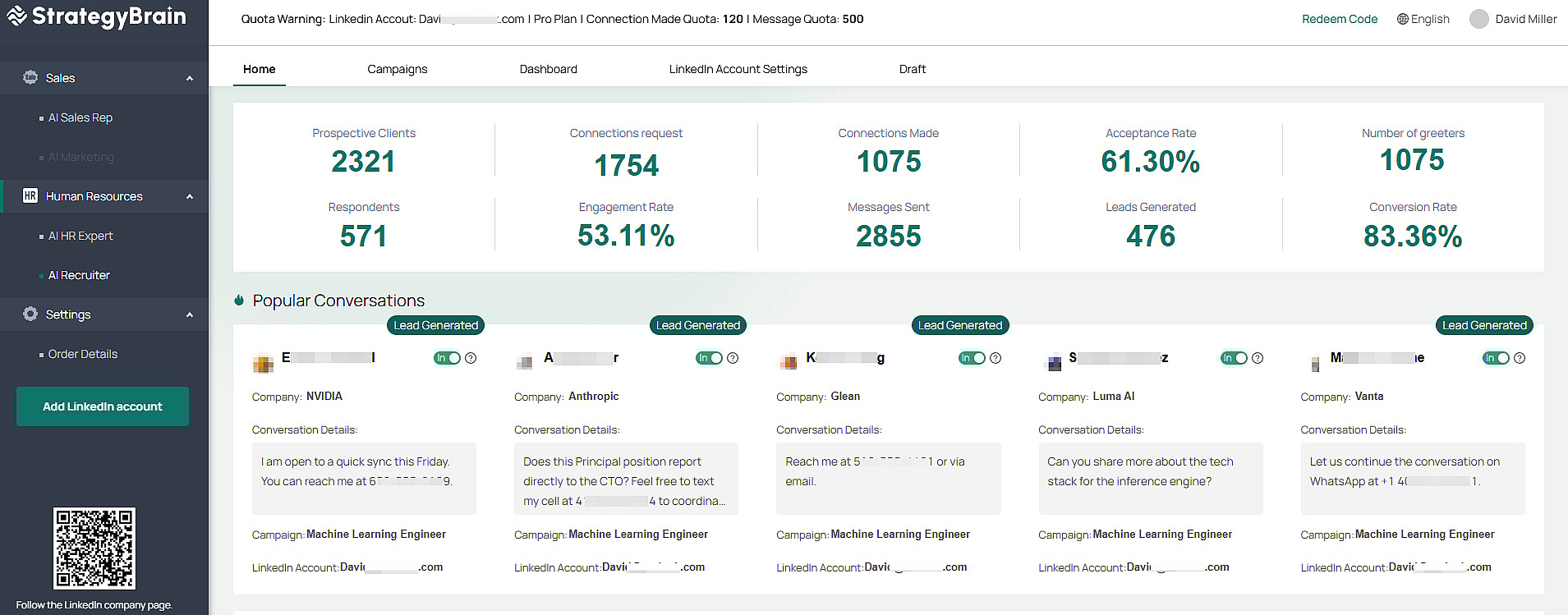
My line manager introduced me to an Al Recruiter tool, promising relief from the relentless grind. For months, it was just my partner and me, facing long hours, endless manual searches, and the constant pressure to fill critical roles. While my manager assured me a new team member was coming, six months passed without a hire, leaving me wondering about the company’s resources.
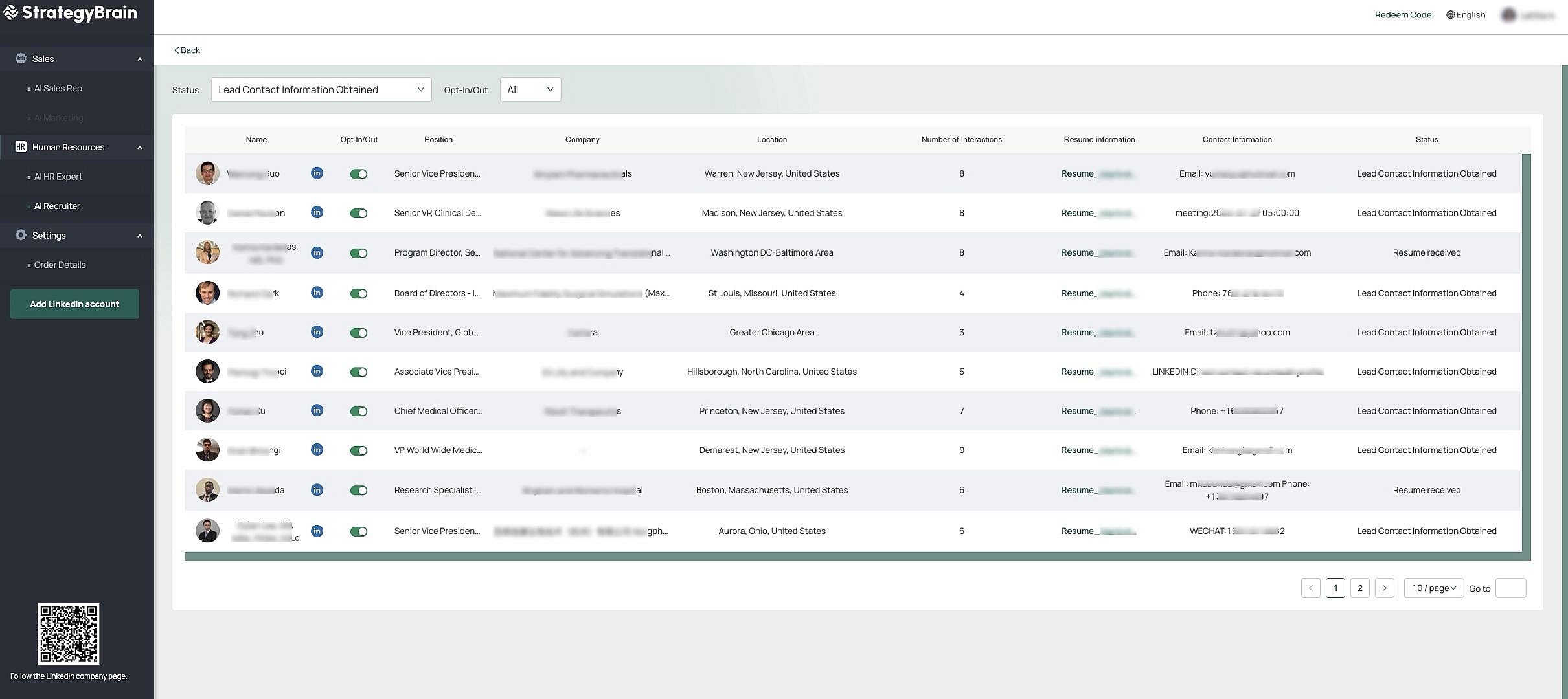
Honestly, I’m a traditional recruiter. I’d never used human resources recruiting software before. I’m not one for trendy tech; I barely use ChatGPT. However, we rely heavily on online platforms, and LinkedIn is undeniably a cornerstone of our work. This Al Recruiter was designed for seamless integration with LinkedIn, and after some recruitment software comparison, it proved to be the most cost-effective option on the market.
“StrategyBrain” was its name. I decided to give it a try. Initially, I was wary. It seemed like this AI recruiting tool could eventually replace me. But the reality was far different.
Before StrategyBrain, my days were consumed by manual LinkedIn searches, limiting me to my immediate network. International recruitment was a logistical nightmare of language barriers and time zone differences. Timely follow-ups? Nearly impossible. I needed a solution that could break through these limitations while staying within our budget.
StrategyBrain stepped in, handling the time-consuming early stages of recruitment. It automatically sourced candidates, initiated outreach, and managed follow-ups—all 24/7. This freed up significant time for me to focus on strategic tasks and candidate engagement.
The multilingual features were a game-changer. While I’m fluent in three languages, projects requiring Arabic-speaking candidates presented a challenge. Google Translate often fell short. StrategyBrain handled these complexities flawlessly, expanding our reach and efficiency.
We all know that LinkedIn is one of the best recruiting platforms, and this tool was designed for use on it. It allowed me to expand my reach, and find the perfect candidate much faster.
Apex Talent Solutions, despite our small size, has a strong reputation for personalized service. StrategyBrain enhanced our capabilities, allowing us to maintain that personal touch while streamlining our processes.
I’m no longer worried about being replaced. Instead, I see it as a powerful ally, helping us deliver even better client results.
Here’s a video that shows how this Al Recruiter works, check it out:
At this point, StrategyBrain AI Recruiter wasn’t just “another tool” — it was a working system inside our day-to-day recruiting process: LinkedIn sourcing, outbound outreach, follow-ups, and multilingual engagement running without burning recruiter hours.
But one successful implementation doesn’t automatically answer the next question every recruiter asks in 2026: Which AI recruiting software is best for my specific bottleneck? Some teams need deeper multi-source search beyond LinkedIn. Others are overwhelmed by inbound applications and need screening automation. Enterprise TA leaders often prioritize skills intelligence, governance, and ATS integration over outbound speed.
That’s why I’m switching from the “how I used StrategyBrain” story to a structured tool-by-tool comparison — ranked by real recruiting outcomes like sourcing speed, automation depth, cost per lead, and ROI.
After 30 years as a headhunter and 6 months testing 15 top ai recruitment tools at Apex Talent Solutions in Silicon Valley, I’ve ranked every platform by real performance — sourcing speed, automation depth, cost per lead, and ROI.
This is an unbiased buyer’s guide, not a vendor pitch. Whether you’re a solo agency recruiter or a corporate TA leader, this comparison will help you find the right ai recruiting software for your specific bottleneck.
To make this comparison honest and useful, I evaluated each platform across 6 consistent dimensions:
I personally tested or reviewed detailed user data for each platform. Where I couldn’t test directly, I referenced verified third-party reviews from IndustryLabs, Tooliverse, and G2.
| Tool | Best For | Sourcing Depth | Automation Level | Starting Price | Ease of Use |
|---|---|---|---|---|---|
| StrategyBrain AI Recruiter | Agencies / Headhunters | LinkedIn Multi-channel | Agentic (Recruit GPT) | High ROI (USD 2.40/lead) | 5/5 |
| Juicebox (PeopleGPT) | Tech Recruiters | 800M+ profiles | AI-native NLP | Free tier available | 5/5 |
| LinkedIn Recruiter | Corporate TA | LinkedIn graph only | Semi-automated | USD 170-1,080/mo | 4/5 |
| SeekOut | Enterprise Teams | 1B+ profiles + GitHub | AI sourcing agents | Custom quote | 4/5 |
| hireEZ | High-Volume Teams | Multi-source outbound | EZ Agent workflow | Custom quote | 4/5 |
| Eightfold AI | Large Enterprises | Internal + external | Skills intelligence | ~USD 7/employee/mo | 3/5 |
| Beamery | Mid-Market Corp | CRM-based | Skills-first lifecycle | Custom quote | 4/5 |
| Paradox (Olivia) | Retail / Hospitality | Applicant pool | Conversational AI | ~USD 1,000/mo | 5/5 |
| SmartRecruiters | Mid-Market ATS-integrated | Winston AI | Transparent entry | — | 4/5 |
| Greenhouse | Tech Startups | ATS-integrated | Interview workflow AI | Custom quote | 3/5 |
| Lever (LeverTRM) | Collaborative Teams | ATS/CRM unified | AI companions | Custom quote | 5/5 |
| Ashby | High-Growth Startups | Analytics-driven | Built-in all-in-one AI | Premium | 5/5 |
| Workable | SMBs | Simplified ATS | Rapid AI implementation | Accessible | 5/5 |
| Findem | Enterprise | 3D signal-based | Relationship signals | Custom quote | 3/5 |
| InterviewFlowAI | High-Volume Screening | Autonomous voice AI phone interviews | — | USD 0.99/interview | 5/5 |
Best for: Agencies, headhunters, and LinkedIn-heavy recruiting teams
Of all the ai tools for recruiting I tested in 2026, StrategyBrain delivers the most measurable ROI for outbound agency recruiting. It operates as a true Recruit GPT execution system — not just scheduling messages, but conducting autonomous multi-turn conversations, answering candidate questions, and qualifying interest without human intervention.
In our testing at Apex Talent Solutions, it reduced our cost per lead from USD 230 (global LinkedIn benchmark) to just USD 2.40, boosted connection rates from 15% to 60%, and drove conversation engagement from 5% to 50%.
The Virtual Recruiter Team feature — running multiple LinkedIn accounts simultaneously — is genuinely transformative for solo headhunters. The 24/7 multilingual engagement (including Arabic and other regional languages) eliminates the “Delay Tax” that loses elite candidates to faster competitors.
The Conversation Tuning feature lets you debug the AI’s logic before it ever touches a real candidate, protecting your brand reputation.
Best for: Tech recruiters and startups sourcing via natural language
Juicebox is one of the most impressive free ai recruiting tools available in 2026. Its natural language search across 800M+ profiles means you can type “senior ML engineer with fintech background in New York” and get genuinely relevant results — not keyword-matched noise.
The free tier makes it accessible for solo recruiters and small agencies testing AI for the first time.
Where Juicebox falls short is depth of automation: it’s an excellent sourcing tool but doesn’t execute outreach autonomously the way StrategyBrain does. Think of it as a powerful discovery engine you still need to drive manually.
Best for: Corporate TA teams already embedded in the LinkedIn ecosystem
LinkedIn Recruiter is the default tool for corporate talent acquisition, and for good reason: its proprietary talent graph is unmatched. At USD 170/month (Lite) to USD 1,080+/month (Corporate), it’s the most expensive option per feature delivered.
The automation is semi-manual — InMail sequences exist but lack the true agentic intelligence of newer ai recruiting software 2026 tools.
Where LinkedIn Recruiter genuinely wins: brand credibility. Candidates trust InMail from LinkedIn more than third-party outreach. If your hiring brand is strong and you’re sourcing 5-10 roles at a time, it remains a solid investment.
Best for: Enterprise teams sourcing hard-to-find technical and diverse talent
SeekOut’s standout feature is data depth: 1B+ profiles enriched with GitHub contributions, patent filings, publications, and DEI signals. For sourcing niche engineering talent or building diverse pipelines, it’s one of the best ai recruitment tools at the enterprise level.
Their AI agents automate outreach and can rediscover candidates already hiding in your ATS (they report 44% of great hires are already in existing databases).
With 750+ enterprise customers and a Tooliverse score of 8.18/10, SeekOut has earned serious credibility. Pricing is custom quote only, which can be a barrier for mid-market teams.
Best for: High-volume outbound recruiting teams
hireEZ’s “EZ Agent” workflow automates the full outbound funnel — sourcing, sequencing, and CRM updates — making it one of the strongest recruiting automation software options for teams handling 50+ reqs simultaneously.
Its multi-source coverage (LinkedIn, GitHub, Indeed, and more) gives it broad reach beyond LinkedIn-only tools.
The interface can feel overwhelming for solo recruiters, and pricing is custom quote only. But for TA teams doing genuine volume, hireEZ delivers consistent funnel coverage without manual handoffs.
Best for: Large enterprises focused on internal mobility and skills intelligence
Eightfold is less a sourcing tool and more a Talent Operating System. Its deep-learning models map skills across your entire workforce, identifying flight risks, internal candidates for open roles, and future skills gaps.
At approximately USD 7/employee/month, it’s significant investment, and implementation is genuinely complex (ease of use: 3/5).
For enterprises with 5,000+ employees struggling with internal mobility and retention, Eightfold delivers ROI that simpler ai tools for recruiting can’t match. For everyone else, it’s overkill.
Best for: Mid-market companies building long-term talent pipelines
Beamery’s skills-first CRM approach makes it uniquely valuable for organizations that want to build talent communities rather than just fill immediate reqs.
Its AI identifies skill adjacencies and nurtures passive candidates over time — a fundamentally different philosophy from outbound sourcing tools.
If your recruiting strategy is reactive (fill reqs as they come), Beamery is not the right fit. If you’re building a 12-month talent pipeline, it’s one of the best ai recruitment tools for that specific use case.
Best for: Retail, hospitality, and healthcare high-volume hourly hiring
Paradox’s conversational AI, Olivia, is purpose-built for mobile-first, SMS-heavy hiring at scale. It screens, qualifies, and schedules interviews autonomously via text and WhatsApp in 100+ languages.
According to SHRM and Paradox’s own 2026 benchmarks, it saves recruiting teams 60-80% of early-funnel time for high-volume roles.
For a Silicon Valley tech headhunter like me, Paradox isn’t the right tool — but for a retailer hiring 500 seasonal workers, it’s genuinely transformative. One of the most innovative ai tools for recruiting in a specific vertical.
Best for: Mid-market companies wanting an all-in-one AI-powered ATS
SmartRecruiters’ “Winston” AI intelligence layer sits across its entire ATS, scoring candidates, flagging bias risks, and automating interview scheduling.
Transparent entry-level pricing makes it one of the more accessible ai recruiting software 2026 options for growing companies that want a single platform.
It doesn’t match specialist sourcing tools for outbound recruiting, but as an integrated system for inbound hiring, it delivers solid value.
Best for: Tech startups prioritizing structured, bias-free hiring
Greenhouse’s AI enhancements focus on interview workflow — structured scorecards, automated scheduling, and interview kit generation. It’s less about sourcing and more about ensuring every candidate gets a consistent, fair evaluation once they’re in the funnel.
Its tight integration with major sourcing tools (including LinkedIn and SeekOut) means it works best as the backend ATS for teams that source elsewhere.
Custom pricing and complexity make it less suited to very small teams.
Best for: Collaborative hiring teams combining ATS and CRM
Lever’s Talent Relationship Management (TRM) approach unifies applicant tracking and candidate nurturing in one platform.
Its AI “Companions” assist with outreach personalization, pipeline analytics, and interview coordination — making it one of the more complete best ai tools for hiring managers who need to align multiple stakeholders.
The unified ATS/CRM approach reduces tool sprawl, which is a genuine operational benefit for teams managing complex hiring processes.
Best for: High-growth startups that live and die by recruiting analytics
Ashby is the fastest-growing ATS among Series B-D startups for a reason: its analytics are genuinely best-in-class.
Built-in AI powers everything from job description optimization to pipeline forecasting, and it’s one of the few platforms where the AI is deeply integrated rather than bolted on.
Premium pricing reflects the quality, but for a high-growth startup where recruiting velocity is a competitive advantage, Ashby pays for itself.
Best for: SMBs that need to get AI recruiting up and running fast
Workable’s strength is speed: most teams are sourcing and screening candidates within hours of signing up.
Its AI features — automated job posting, candidate scoring, and interview scheduling — cover the essentials without enterprise complexity.
For a 50-person company hiring 10-20 people per year, Workable delivers the best balance of ai tools for recruiting capability and simplicity.
It won’t out-source SeekOut or out-automate StrategyBrain, but it doesn’t need to.
Best for: Enterprise teams using relationship signals for strategic sourcing
Findem’s “3D Data” approach enriches candidate profiles with company growth signals, funding events, and relationship data — giving recruiters a strategic edge in knowing when to reach out, not just who to reach.
Its signal-based sourcing is genuinely differentiated from profile-matching tools.
The complexity (ease of use: 3/5) and enterprise-only positioning limits its accessibility, but for strategic talent intelligence at large organizations, Findem offers capabilities no other tool matches.
Best for: High-volume teams needing to screen hundreds of candidates fast
At USD 0.99 per interview, InterviewFlowAI is the most cost-effective screening tool in this comparison.
Its autonomous AI conducts structured phone interviews, scores responses, and delivers ranked candidate lists — enabling teams to screen 500 candidates in the time it would take a human to interview 20.
The trade-off is nuance: it’s excellent for early-stage screening of high-volume roles but shouldn’t replace human interviews for senior or complex positions.
Yes, AI Recruiter fully supports LinkedIn Recruiter's paid features, enabling you to maximize the value of your subscription. It integrates seamlessly with LinkedIn Recruiter, enhancing your recruiting workflow.
AI Recruiter provides complete reporting that allows you to see key data points such as candidate engagement, lead generation and hiring process, which would allow you to make better, data driven decisions.
Yes, AI Recruiter has full multilingual capabilities and will automatically interact with the candidate in their native language without you having to do any kind of translation.
AI Recruiter can answer basic candidate questions and identify the candidates that express interest for your jobs and respond to them to gather resumes, contact information etc., and the complex questions that may need human intervention can be passed to your team.
Yes, you have full control over the outreach messages and job information shared by AI Recruiter. You can tailor them to reflect your employer brand and job specifics.
AI Recruiter handles initial screening and repetitive tasks, but it is designed to complement, not replace, the valuable human interactions that recruiters excel in for deeper evaluations and candidate management.
AI Recruiter manages the full candidate lifecycle, from the initial outreach to interest verification, answering questions, and finally, collecting resumes, ensuring all steps are fully automated.
By automating most of the candidate outreach process, AI Recruiter significantly reduces cost-per-hire, increases hiring speed, and allows you to achieve your hiring goals more efficiently, drastically increasing the ROI of your recruitment efforts. AI Recruiter replaces human intervention in initial contact, therefore reducing the cost per candidate lead to $2.40, and enables you to recruit even if you don't have a recruiter on the team, making the ROI of AI Recruiter extremely high.
AI Recruiter offers flexible pricing options, including Lite, Pro, and Prime plans to accommodate various team sizes. A 10-day free trial is available without requiring a credit card, allowing you to experience the full capabilities of AI Recruiter.
AI Recruiter is designed for ease of use, with a straightforward setup process. Most users can begin their automated recruitment process in minutes, without any technical expertise.



©Strategybrain Technology Ltd.
info@strategybrain.ca